Writing numbers up to 20
Another skill that kids need to master in math is writing numbers up to 20. This skill helps them communicate their mathematical thinking using symbols and words. To help kids practice this skill, we have included worksheets that ask them to write numbers in different forms.
For example, in one worksheet, they must practice writing numbers from 1 to 20 in numerals. In another worksheet, they must practice writing numbers from 1 to 20 in words.
Practice writing numbers in words up to 20
Writing numbers in words is a challenging skill for many kindergarten students because it involves spelling and following rules for writing different types of numbers up to 20.
To help kids practice this skill, we have included worksheets that ask them to write numbers in words using different methods.
For example, in one worksheet, they have to trace and write numbers in words from 1 to 10. In another worksheet, they have to fill in the missing letters for numbers from 11 to 20.
Writing numbers from figures to words
Another way to help kids practice writing numbers in words is by asking them to write numbers from figures (numerals) to words up to 20. This is a great way to reinforce their understanding of how numerals and words represent the same quantity. For example, in one worksheet, they must write numbers from figures (like 14) to words (such as fourteen). In another worksheet, they must match numbers from figures (like 16) to words (such as sixteen).
Counting and writing numbers up to 20
A more advanced skill kids need to learn in math is counting and writing numbers up to 20.
This skill helps them combine their knowledge of counting objects, using models, and writing numbers in different forms. To help kids practice this skill, we have included worksheets that ask them to count and write numbers up to 20 using different methods.
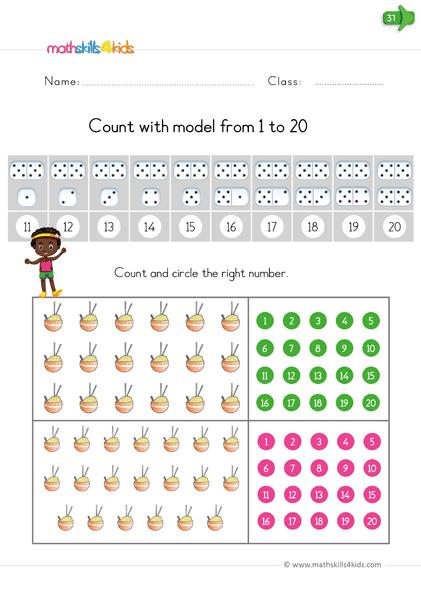
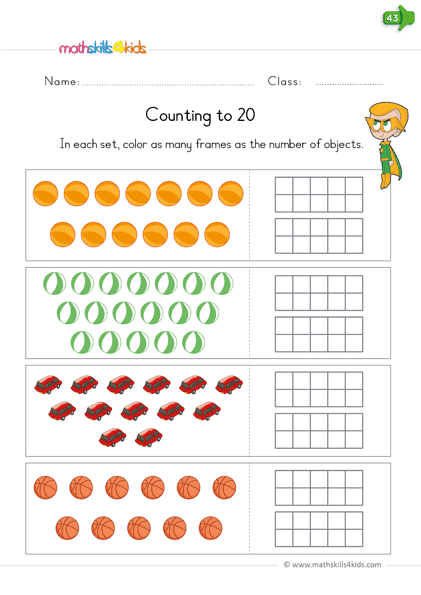
For example, in one worksheet, they must count the objects in each set and write the number in numerals.
In another worksheet, they have to find and write the missing numbers in a sequence of numbers.
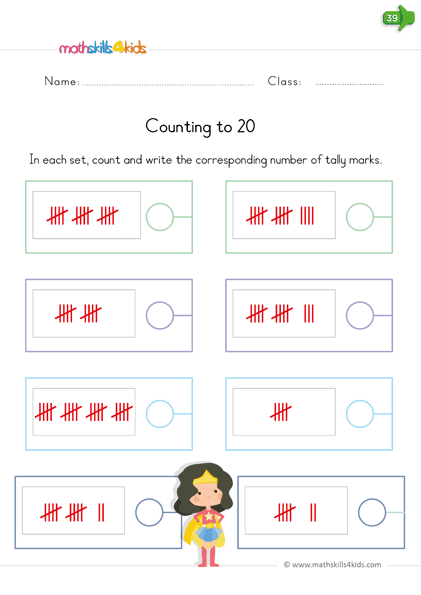
In another worksheet, they must count tally marks and write the corresponding numbers.
Counting up to 20, then write down the correct answer
One of the simplest ways to practice counting and writing numbers up to 20 is by asking kids to count the objects in each set and write down the correct answer in numerals. This helps them develop their number sense and recall skills.
For example, in one worksheet, they must count the birds and write the number in a box. In another worksheet, they must count the buttons and write the number on a line.
Find and write the missing numbers
Another way to practice counting and writing numbers up to 20 is by asking kids to find and write the missing numbers in a sequence of numbers. This helps them develop their pattern recognition and problem-solving skills.
For example, in one worksheet, they have to find and write the missing numbers in ascending order. In another worksheet, they have to find and write the missing numbers in descending.
Counting tally marks up to 20 and write the corresponding numbers
This worksheet reinforces using tally marks to represent numbers up to 20. Your kids will have to count the tally marks in each row and write the number that corresponds to them. For example, if they see five tally marks, they will write 5.
This worksheet will also help them practice writing numbers neatly and correctly.
Counting blocks by fives and write the answer
This worksheet is perfect for introducing the idea of skip counting by fives. Your kids must count the blocks in each fives group and write the answer.
For example, if they see three groups of five blocks, they will write 15.
This worksheet will also help them recognize patterns and sequences in numbers.
Counting to 20 tens and ones
This worksheet is ideal for teaching the place value of tens and ones. Your kids must count the tens and ones in each box and write the number representing them.
For example, if they see two tens and three ones, they will write 23. This worksheet will also help them understand how numbers are composed of different parts.