
2nd Grade Money Math

Grade 2 money math worksheets and activities for Kids: Printable and free

Help your second grader master money math with these free printable worksheets and activities. Perfect for at-home and classroom learning!

What your child will practice

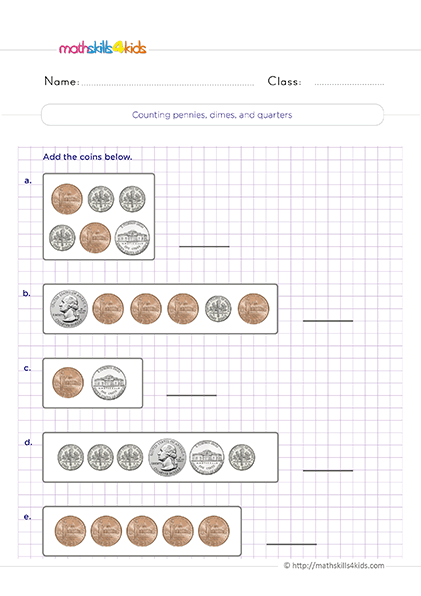
  • Counting pennies nickels dimes and quarters
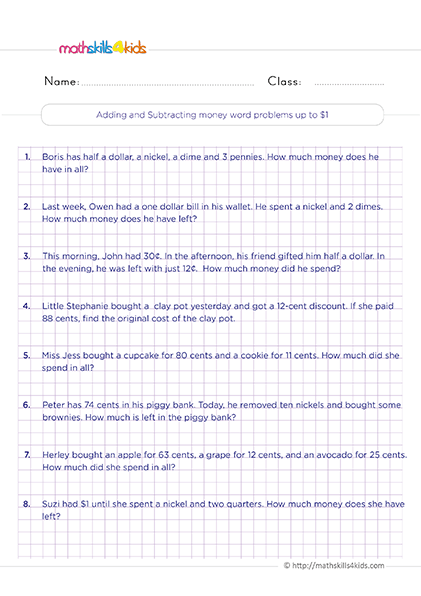
  • Adding & subtracting money
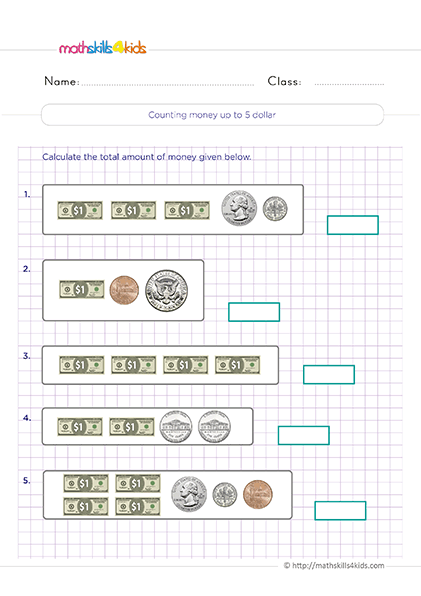
  • Counting money up to $5
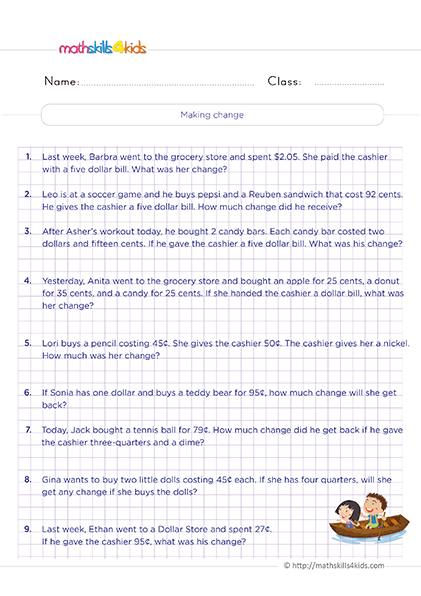
  • Making change

Skills on this page

Worksheets, games and printables

5 resources

Learn, practice and play

Why money math matters: How to help your child develop essential skills

One of our objectives in this resource is to help 2nd graders understand why money math matters and help them develop essential math skills at an early age.

  • Money math is more than just counting coins and bills. It is a skill that involves many aspects of mathematics, such as number sense, place value, addition, subtraction, multiplication, division, fractions, decimals, percentages, and more.

    Money math also helps your child develop other skills, such as:

    • Critical thinking: Money math challenges your child to think logically and creatively about how to solve problems involving money.
    • Financial literacy: Money math teaches your child the basics of money management, such as saving, spending, budgeting, and investing.
    • Life skills: Money math prepares your child for real-life situations that involve money, such as shopping, banking, tipping, taxes, and more.

      To help your child develop these skills, you can:

    • Talk to your child about money: Explain where money comes from, how it is used, and why it is important.

      Use everyday examples to show your child how money works in different contexts.

    • Involve your child in money decisions: Let your child participate in making decisions about money, such as planning a grocery list, comparing prices, choosing what to buy, paying at the cashier, and checking the change.
    • Play games with your child involving money: Games are a great way to make learning fun and interactive.

      You can play games with your child using real or pretend money, such as coin toss, coin bingo, coin matching, coin sorting, coin war, coin race, etc.

    • Praise your child for their efforts and achievements: Encourage them to practice money math skills and celebrate their progress.

      Give them positive feedback and recognition for their hard work and improvement.
Understand the concepts

Fun and engaging Grade 2 money math worksheets and activities for kids: What you need to know

If you are looking for some fun and engaging money math worksheets for grade 2 students, you have come to the right place!

We have selected a set of printable and free Grade 2 money math worksheets and activities for kids from Mathskills4kids.com that cover various topics related to money math for your students.

These worksheets are designed to help your child practice and master the following skills:

  • Name and value of coins: Your child will learn the names and values of different coins (pennies, nickels, dimes, and quarters) and how to write them using symbols ($ or ¢).
  • Counting pennies, nickels, dimes, and quarters: Using skip counting or grouping strategies will help your child learn to count coins of different values up to $1.
  • Counting money up to $1: Your child will learn to count mixed coins up to $1 using addition or place value strategies.
  • Equivalent amount of money up to $1: Your child will learn to find different ways of making the same amount up to $1 using coins of different values.
  • Exchanging money with pictures: Using pictures, your child will learn to exchange coins of different values for equivalent coins.
  • Comparing coins: Your child will learn to compare coins of different values using symbols (<, >, or =).
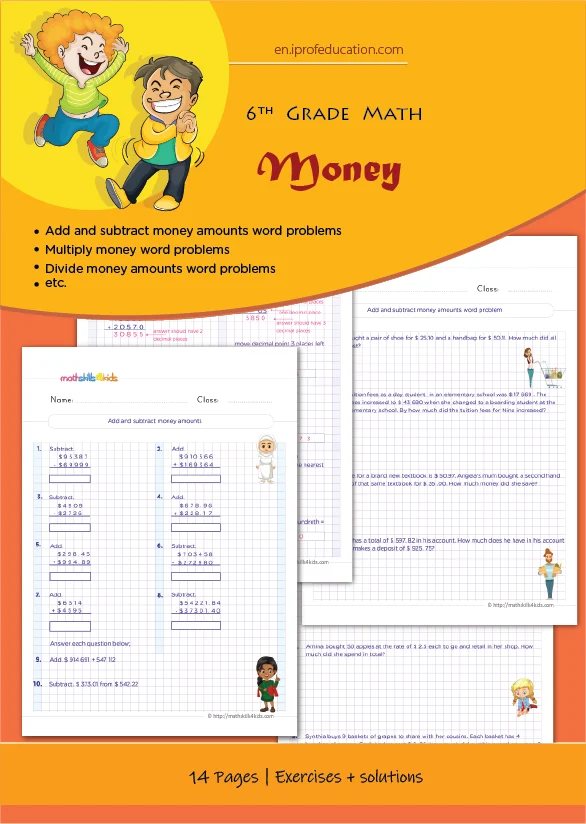
  • Adding and subtracting money word problems: Your child will learn how to solve problems involving adding or subtracting money amounts up to $1 using strategies such as drawing pictures, making a table, or using a number line.
  • Purchase with an amount up to $5: Do you have enough?: Your child will learn to determine if they have enough money to buy an item with a given price of up to $5 using strategies such as counting on, subtracting, or comparing.
  • Comparing money amount with pictures: up to $5: Your child will learn how to compare money amounts to $5 using pictures and symbols (<, >, or =).
  • Making change: Your child will learn how to find the change from a given amount of money up to $5 using strategies such as counting back, subtracting, or using a number line.
  • And more: Your child will also learn other skills related to money math, such as estimating, rounding, ordering, and patterning.

These worksheets suit grade 2 students learning or reviewing money math skills. They also align with the Common Core State Standards for Mathematics for grade 2.

You can use these worksheets as homework, classwork, assessment, or enrichment activities for your child.

How to use the money math worksheets: Tips and tricks for parents and teachers

To use the money math worksheets effectively, we have provided some tips and tricks for parents and teachers:

  • Print the worksheets in color or black and white: You can choose to print the worksheets in color or black and white, depending on your preference and availability of resources.

    If you print them in black and white, you can ask your child to color the coins or use colored pencils or markers to make them more attractive.

  • Laminate the worksheets or use sheet protectors: You can laminate them or use sheet protectors to make them reusable and durable.

    This way, you can save paper and ink, and your child can use dry-erase markers or crayons to write on them.

  • Use real or pretend coins: You can use real or pretend coins to make the worksheets more interactive and realistic.

    You can ask your child to match, count, compare, exchange, or make change with the coins as they work on the worksheets.

  • Use manipulatives or tools: You can use manipulatives or tools to help your child visualize and solve the problems on the worksheets.

    For example, you can use counters, base ten blocks, ten frames, hundred charts, number lines, etc., to help your child with counting, adding, subtracting, or making change.

  • Check the answers with your child: After they finish each worksheet, you can check the answers with your child. You can use the answer keys provided at the end of each worksheet or a calculator to check the answers.

    You can also ask your child to explain their thinking and strategies as they check their answers.

  • Give feedback and encouragement: You can give feedback and encouragement to your child as they work on the worksheets. You can point out their strengths and areas of improvement and give them suggestions on how to improve their skills.

    You can also praise their efforts and achievements and motivate them to keep practicing and learning.

10 fun and engaging real-life money word problems

To make money math more enjoyable for your child, you can challenge them with 10 fun and engaging real-life money word problems.

These word problems are based on situations your child may encounter daily, such as going to a store, a restaurant, a movie theater, a park, etc.

These word problems will help your child apply their money math skills in a meaningful and relevant way.

Here are 10 examples of real-life money word problems for grade 2 students:

  1. Anna has 3 quarters, 4 dimes, and 2 nickels in her piggy bank. How much money does she have in total?
  2. Ben wants to buy a toy car that costs $2.50. He has 2 dollar bills and 6 quarters. Does he have enough money to buy the toy car? How much change will he get back?
  3. Cindy has a lemonade stand. She sells each cup of lemonade for 25 cents. She sold 12 cups of lemonade on Monday, 15 on Tuesday, and 18 on Wednesday. How much money did she make in total?
  4. David has 5and5 and10 bills in his wallet. He wants to buy a book that costs 12andacandybarthatcosts12 and a candy bar that costs1. How much money will he have left after buying both items?
  5. Emma wants to save up for a new bike that costs 100.Shegets100. She gets10 every week for doing chores. How many weeks will it take her to save enough money for the bike?
  6. Frank has a jar of coins. He has 20 pennies, 15 nickels, 10 dimes, and 5 quarters. He wants to exchange them for bills at the bank. How much money will he get in bills?
  7. Grace is having a garage sale. She sells a doll for 3,apuzzlefor3, a puzzle for2, and a board game for 4.Shealsobuysacomicbookfromherneighborfor4. She also buys a comic book from her neighbor for1. How much money does she have at the end of the day?
  8. Henry is going to the movies with his friends. A movie ticket costs 8,andapopcorncosts8, and a popcorn costs3. He has a coupon that gives him $2 off the movie ticket. How much money does he need to pay for the movie and the popcorn?
  9. Isabella is buying ice cream for herself and her sister. She wants a cone with two scoops of chocolate ice cream for 2perscoop.Hersisterwantsacupwithonescoopofvanillaicecreamthatcosts2 per scoop. Her sister wants a cup with one scoop of vanilla ice cream that costs1.50 per scoop. How much money do they need to pay for the ice cream?
  10. Jake is collecting coins for his coin collection. He has 5 pennies from 2010, 4 nickels from 2015, 3 dimes from 2020, and 2 quarters from 2021. What is the total value of his coin collection?

How did you do? Did you enjoy solving these money word problems?

If you want more practice, check out some of the websites, apps, books, and games listed below.

Train with exercises

Where to find more resources and activities for money math: Websites, apps, books, and games

Money math is not only an important skill for school but also life. The more you practice, the more confident and comfortable you will be with handling money in different situations.

Here are some of the resources and activities that you can use to learn more about money math:

* Websites: Many websites offer interactive games, quizzes, videos, and worksheets on money math topics such as counting coins, making change, comparing prices, budgeting, saving, and spending.

* Apps: You can also download many apps on your phone or tablet that can help you practice money math skills fun and engagingly.

*Books: Reading books about money can also help you learn more about money’s history, value, and use in different cultures and contexts. You can also find books that have stories, puzzles, and activities related to money math.

*Games: Playing games with money can also be a fun and effective way to practice money math skills. You can use real or fake coins, bills, cards, dice, spinners, or other tools to create games.

Fun activities and games

About money math in 2nd Grade

Hi everyone! Welcome to another interesting article about money math for kids. Today, we will talk about Grade 2 money math worksheets and activities that you can use to help your child learn about money in a fun and engaging way. These money math activities for kids are printable and free to download. So, quickly assess them from Mathskills4kids.com and enjoy this amazing moment with your kids at home and in the classroom.

Money math is an important skill that every child needs to develop, as it helps them understand the value of money, how to use it wisely, and how to solve real-life problems involving money.

In this article, you will find:

Let's get started!

Free or Premium: what to know

Free Opens right away: print the PDF or play in the browser, no account needed.
Compare plans

Printable math packs from Tizofun Education

See all (opens the Tizofun Education shop in a new tab)