Understanding integers
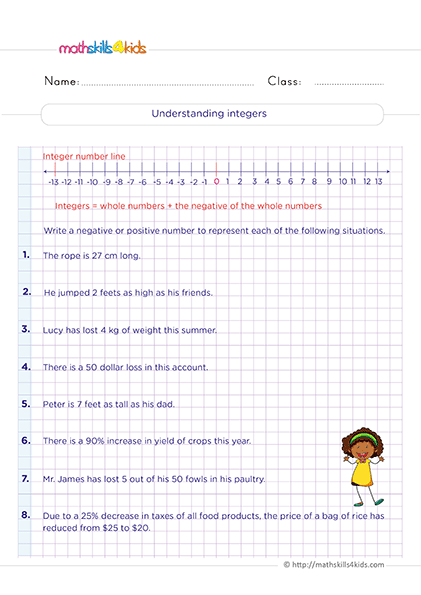
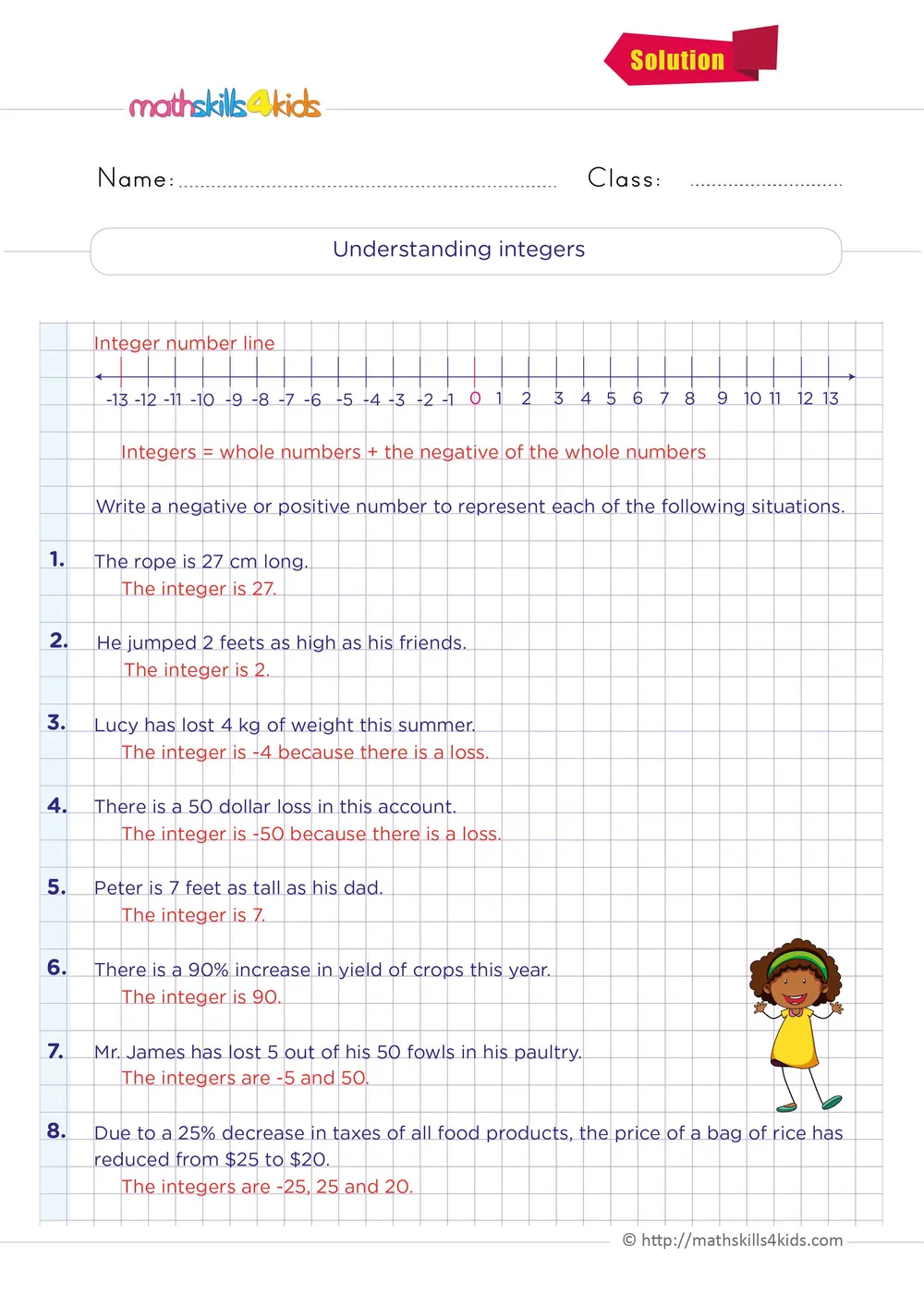
Check a bank app or a bathroom scale and you will see that every number has a direction: up or down, gained or lost. Here your child practices using positive and negative numbers for gains and losses across eight short situations, from a 27 cm rope to a $50 loss in an account. A number line from −13 to 13 sits at the top as a guide, and page 2 gives the answers.
Why does a loss get a minus sign?
Integers add a direction to the counting numbers your child already knows. A gain, a rise or something you simply have is positive; a loss or a drop is negative. The page puts that rule to work in plain sentences: Lucy loses 4 kg, so the number is −4, while the 27 cm rope stays 27.
The standard is 6.NS.C.5, using positive and negative numbers together for quantities with opposite directions or values.
Item 8 asks for more than one number. The rice price falls from $25 to $20 after a 25% tax cut, and the answer page lists −25, 25 and 20, so your child sees that one sentence can hold several signed numbers.
The trick hiding in item 7
Read item 3 aloud and pause: "Did Lucy's weight go up or down?" Once your child says down, the minus sign has a reason, not just a rule.
Item 7 is where children slip. Mr. James lost 5 of his 50 fowls, and many write only 5. Ask, "Which number is the loss, and which is what he had?" The key wants −5 and 50.
Before you check the key: item 5 is worded oddly, so read it as Peter being 7 feet taller than his dad and accept 7. For item 8, a child who writes −5 for the $5 drop in price has found a fair answer the key leaves out.
Signs you can find before dinner
In an elevator, the buttons below the lobby often read B1 and B2; ask your child which signed numbers those floors would be. On the next grocery receipt, find a discount and write it as a negative amount next to the price.
Millions to Measure, by David M. Schwartz, is about units of length, weight and volume, the same kinds of measurements behind the rope, the jump and Lucy's weight; reading it together gives the units a story.
Name the habit you saw: "You asked up or down before writing a sign." Next in the series is what is absolute value, where the distance from zero matters more than the sign.
About this 6th Grade integers worksheet
Download the worksheet: Understanding integers
Download the PDF (opens in a new tab)Free · 2 pages · 826 KB · answer key included
🍪 Free worksheets are paid for by ads
To download for free, please accept cookies, or go Premium for an ad-free experience.
A few related activities
What is absolute value
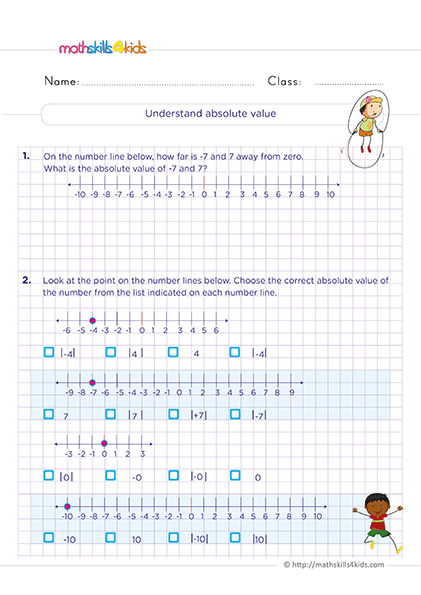
Printable PDF: 6th Grade integers practice, 2 pages, answer key included.
See the activity: What is absolute valueAbsolute value and opposite integers
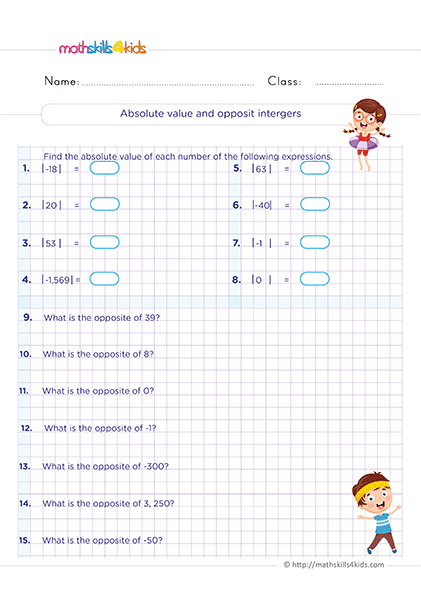
Printable PDF: 6th Grade integers practice, 2 pages, answer key included.
See the activity: Absolute value and opposite integersHow to compare integers
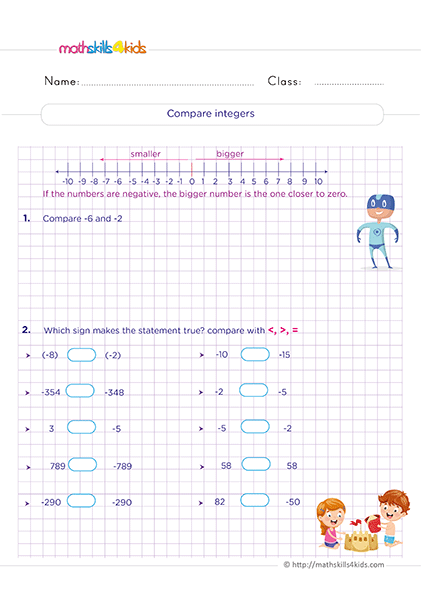
Printable PDF: 6th Grade integers practice, 2 pages, answer key included.
See the activity: How to compare integersHow to put integers in order
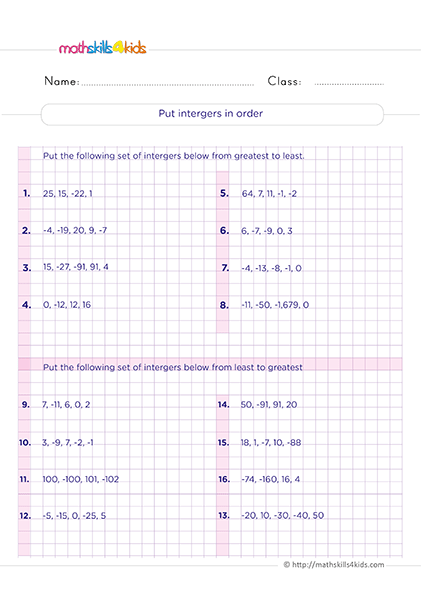
Printable PDF: 6th Grade integers practice, 2 pages, answer key included.
See the activity: How to put integers in orderIntegers and absolute values
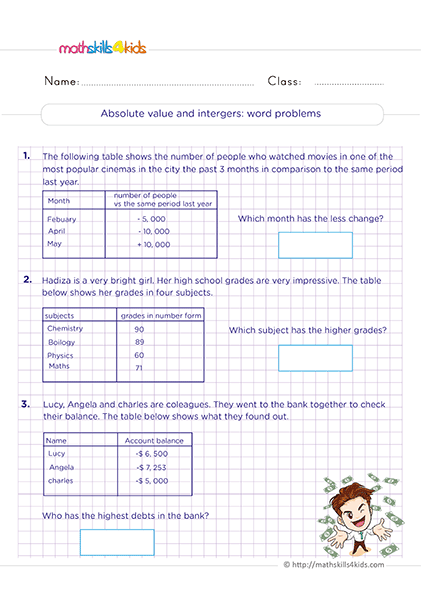
Printable PDF: 6th Grade integers practice, 2 pages, answer key included.
See the activity: Integers and absolute valuesThe place value of digits in whole numbers
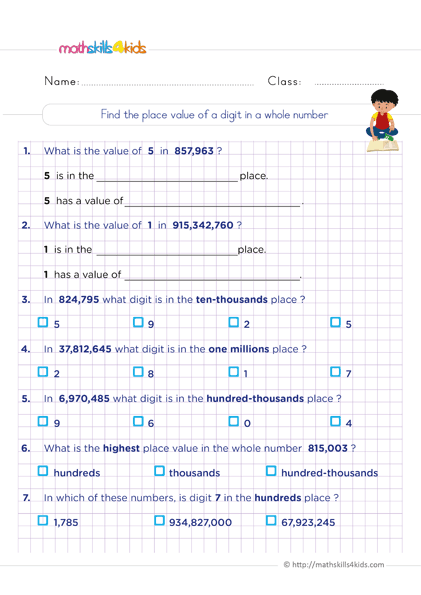
Printable PDF: 6th Grade whole numbers practice, 2 pages, answer key included.
See the activity: The place value of digits in whole numbers