How to place decimals on the number line practice
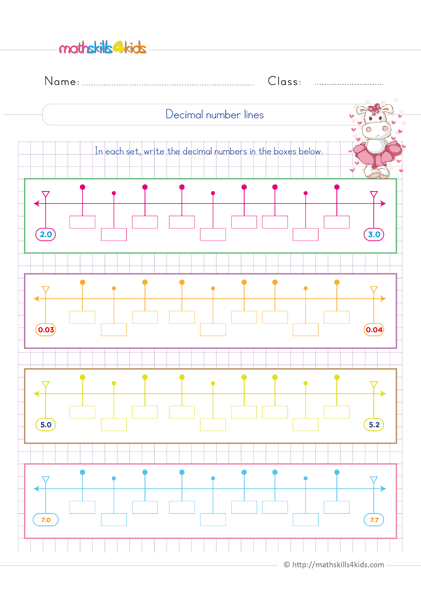
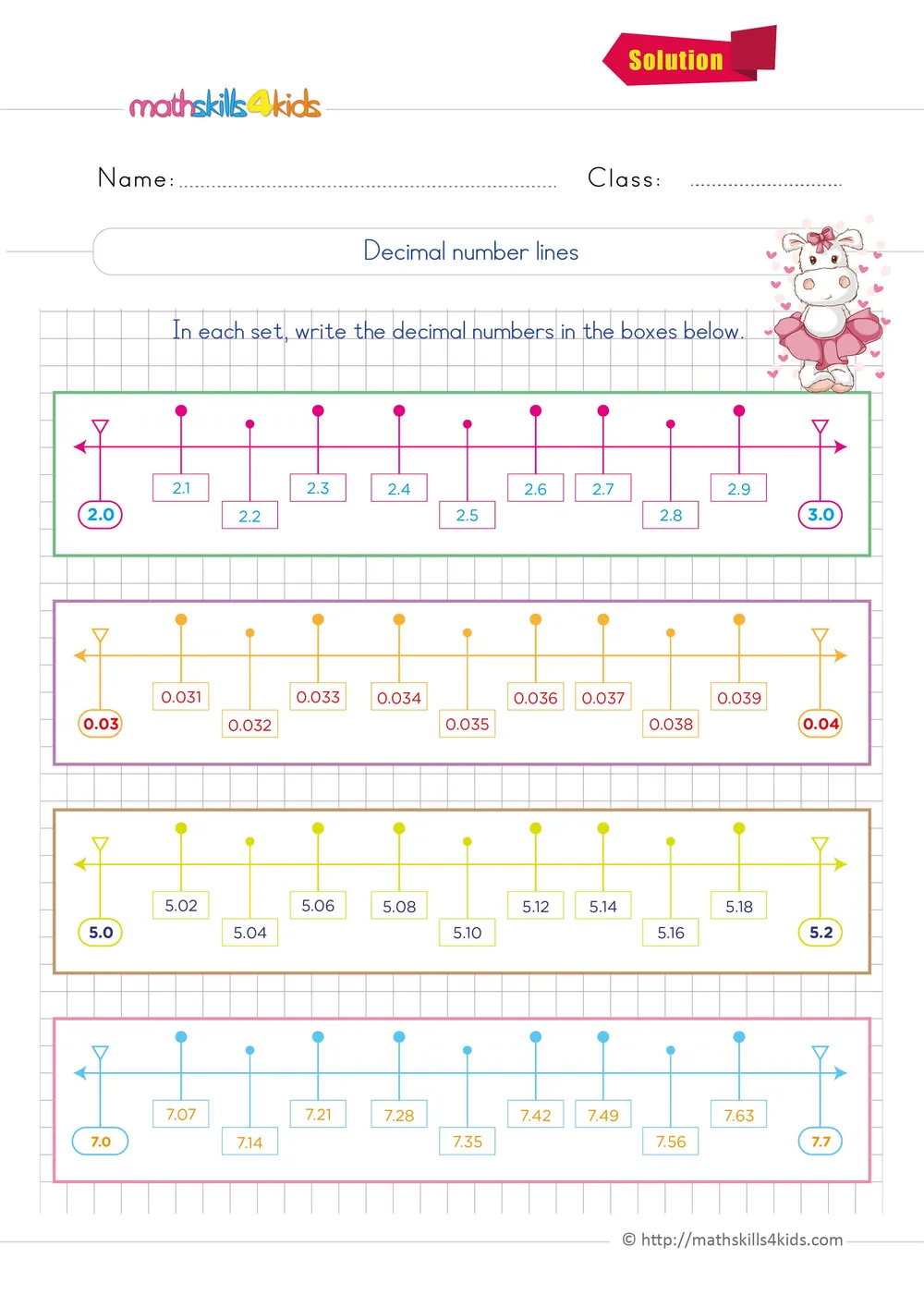
Imagine stretching the gap between 0.03 and 0.04 until it fills a whole row of a notebook. That is the move your child makes here, placing decimals on a number line by splitting four lines into ten equal jumps and writing a number in each of the nine boxes. The jumps get harder as the page goes on: tenths, thousandths, two hundredths, then seven hundredths. Page 2 fills every box.
Zoom in until the gap is wide
A number line works like a zoom lens. Between 0.03 and 0.04 there is room for 0.031, 0.032 and every thousandth up to 0.039, and the page draws that room out wide so your child can see it.
The four lines also change the size of each jump. From 2.0 to 3.0 the step is one tenth. From 5.0 to 5.2 it is two hundredths, and from 7.0 to 7.7 it is seven hundredths, so your child must first find the step: the gap divided by ten. That planning is the heart of finding the step size on a number line.
The standard is 6.NS.C.6, understanding a rational number as a point on the number line.
What is one jump worth?
Cover page 2 and start with the last line, 7.0 to 7.7. Ask, "How many jumps are there, and how big is each one?" Many kids write 7.1, 7.2, 7.3 because the first line went up in tenths. Count the gaps together: ten jumps share 0.7, so each is 0.07, and the boxes read 7.07, 7.14, 7.21 and on up to 7.63.
On the 5.0 to 5.2 line, the middle box is 5.10. Ask, "Is 5.10 the same as 5.1?" It is, and that is a good moment to say why.
The big and small dots on the stems only alternate the box heights; they do not mean different sizes.
Find a number line in the kitchen
A measuring cup is a number line standing up: the marks between 0 and 1 cup split it into equal parts. Ask your child where 0.5 or 0.75 of a cup would sit. A car trip works too: when the next exit is 2.4 miles away, the trip meter counts tenths until you get there.
Full House: An Invitation to Fractions by Dayle Ann Dodds shares one cake into equal slices for everyone at an inn. Draw that cake as a line from 0 to 1 and the cuts become points.
Celebrate the effort: "You found the step before you wrote a single number." This sheet closes the decimals series; going back to the grid sheet shows the same tenths as columns.
About this 6th Grade decimals worksheet
Download the worksheet: How to place decimals on the number line practice
Download the PDF (opens in a new tab)Free · 2 pages · 630 KB · answer key included
🍪 Free worksheets are paid for by ads
To download for free, please accept cookies, or go Premium for an ad-free experience.
A few related activities
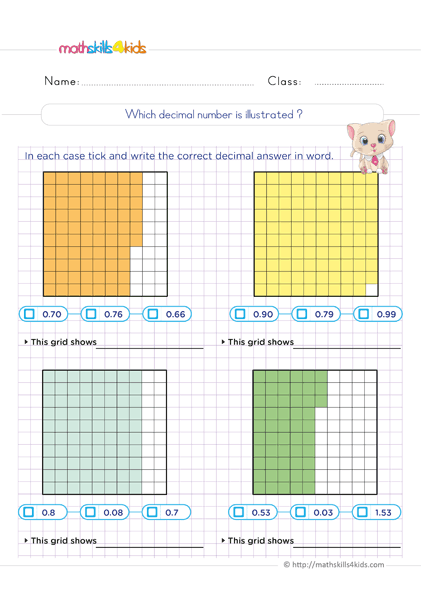
Which decimal number is illustrated practice
Printable PDF: 6th Grade decimals practice, 1 page.
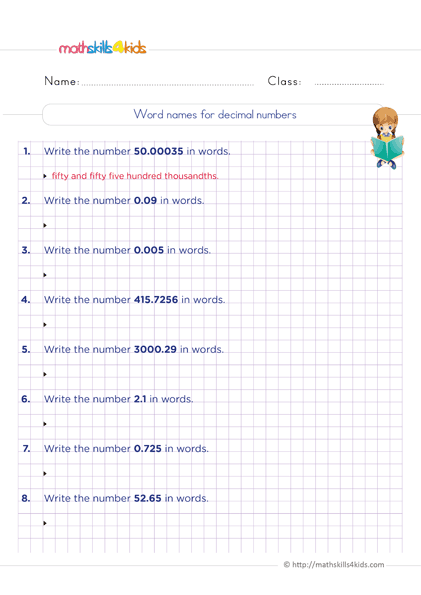
See the activity: Which decimal number is illustrated practiceReading and writing decimals in words practice
Printable PDF: 6th Grade decimals practice, 2 pages, answer key included.
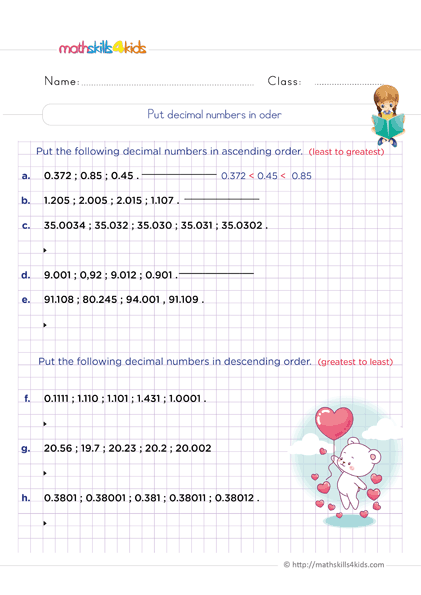
See the activity: Reading and writing decimals in words practicePutting decimal numbers in orders
Printable PDF: 6th Grade decimals practice, 2 pages, answer key included.
See the activity: Putting decimal numbers in ordersInequalities with decimals
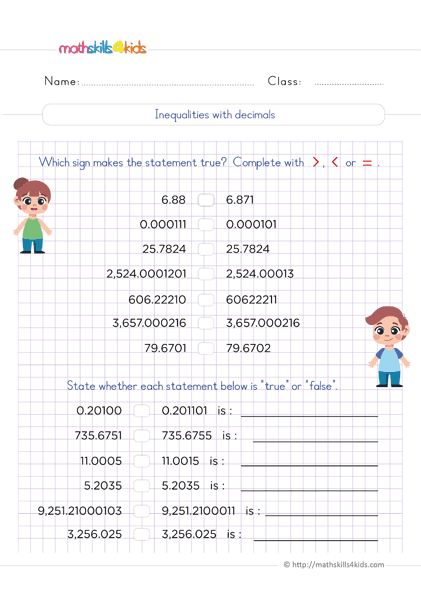
Printable PDF: 6th Grade decimals practice, 2 pages, answer key included.
See the activity: Inequalities with decimalsRounding decimals
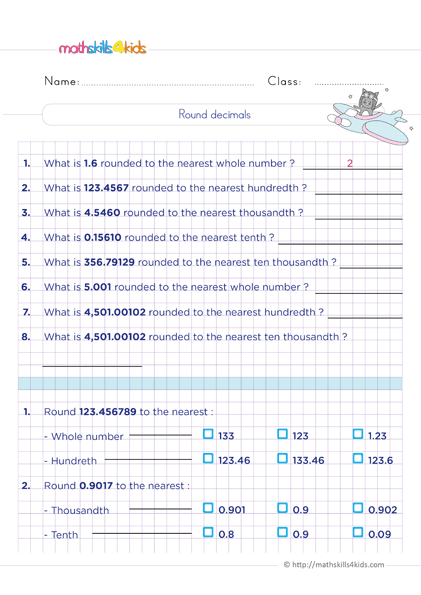
Printable PDF: 6th Grade decimals practice, 2 pages, answer key included.
See the activity: Rounding decimalsThe place value of digits in whole numbers
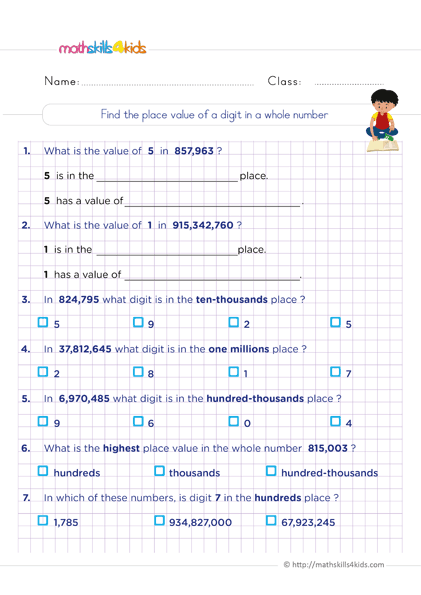
Printable PDF: 6th Grade whole numbers practice, 2 pages, answer key included.
See the activity: The place value of digits in whole numbers