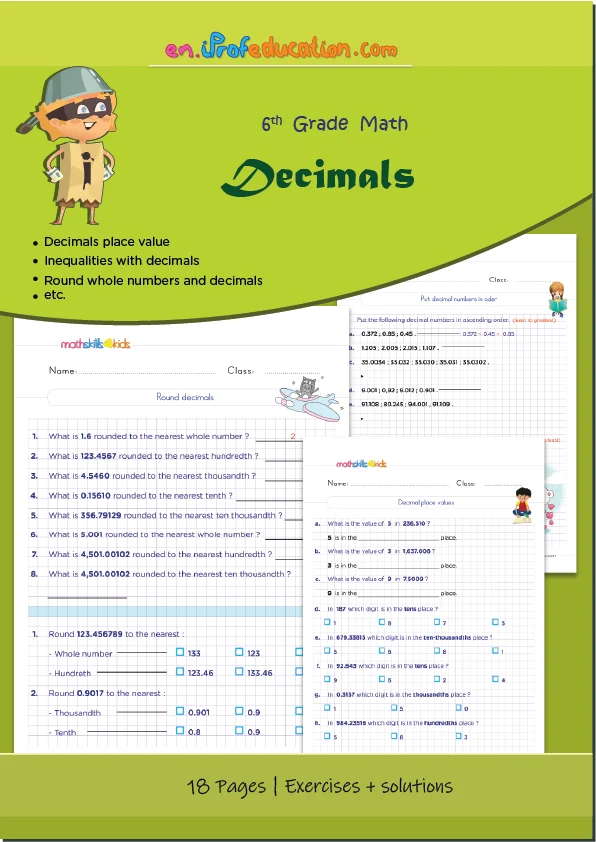
Putting decimal numbers in orders
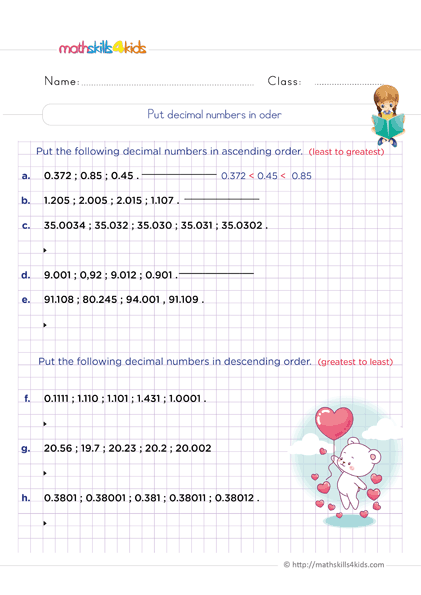
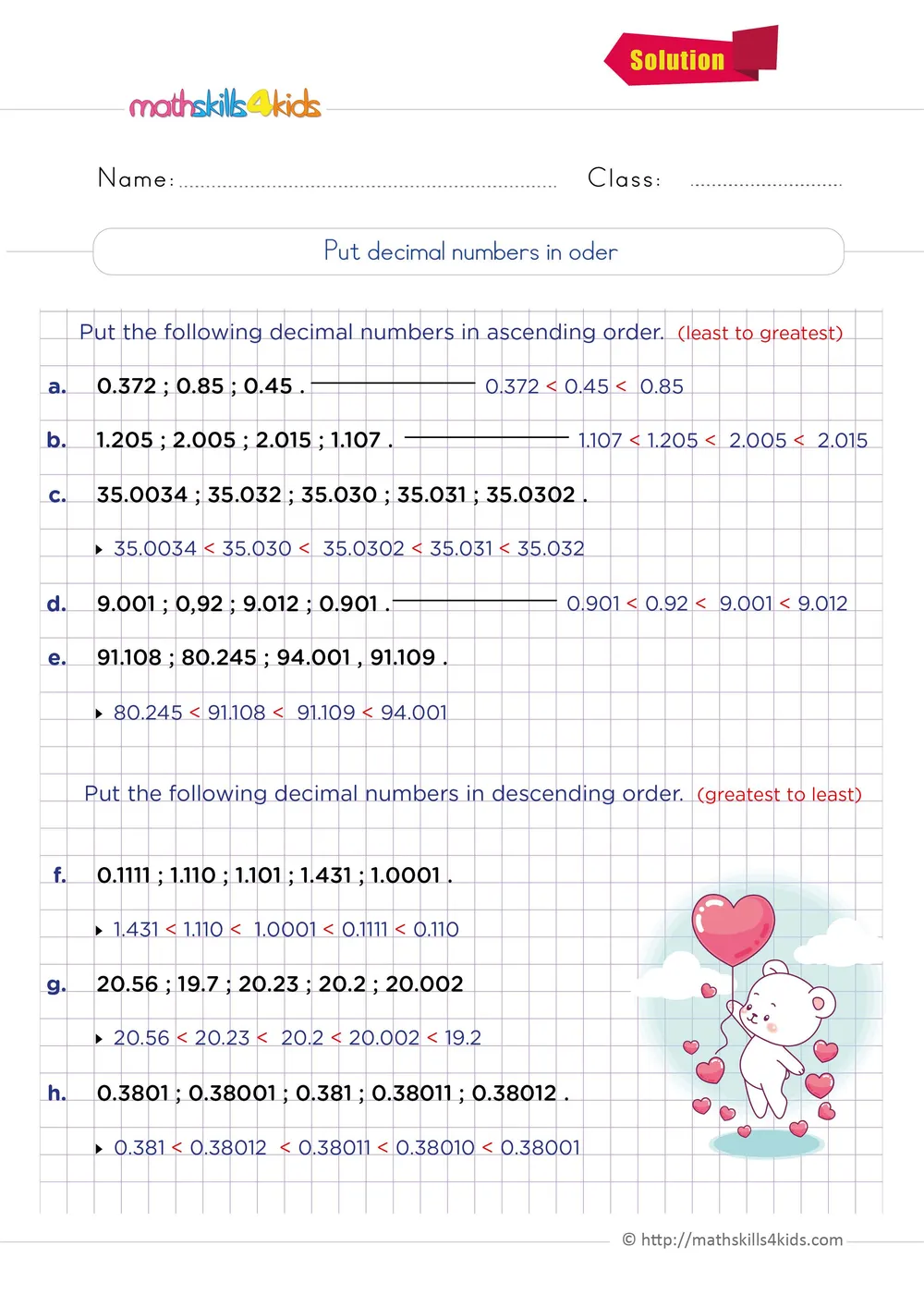
Which is bigger, 0.92 or 9.001? Most kids answer in a heartbeat, then stall on 35.0302 against 35.031. Your child works through five sets ordering decimals from least to greatest, then flips to greatest to least for three more, with numbers that share long runs of the same digits. Page 2 shows every ordered list, though a few lines need a parent's eye first.
Line up the points, then race
Comparing decimals is a left-to-right race. Line the numbers up by their decimal points, find the first place where the digits differ, and that place decides. Length tells you nothing: 35.0034 has more digits than 35.032 and is still smaller.
The page makes this hard in a useful way. Set c packs five numbers that all begin with 35.0, and set h holds five numbers that begin with 0.38, so your child has to look three or four places deep. Writing a zero on the end, as in 35.030, is a fair trick for comparing decimals with different lengths.
The skill is the compare part of 5.NBT.A.3, and putting positive rational numbers in order leads straight into 6.NS.C.7.
Who really wins set f?
Hand your child a pencil and ask, "Which digit do you check first?" In set d, many kids put 9.001 before 0.92 because the zeros make it look small. Ask, "How many whole ones does each number have?"
In set f, 1.110 and 1.101 differ only in the hundredths. Let your child find that spot before deciding.
A note for parents on page 2: the three descending lists use the less-than sign where greater-than belongs. List f drops 1.101 and adds a 0.110 that is not in the question; the right order is 1.431, 1.110, 1.101, 1.0001, 0.1111. List g writes 19.2 for 19.7, which still comes last. Set d prints 0,92 with a comma: read it as 0.92.
Who is tallest on the doorframe?
Measure everyone at home with a tape measure in meters and write the heights as decimals, such as 1.52, 1.5 and 1.47. Ask your child to line them up from shortest to tallest, then explain why 1.5 beats 1.47. Food labels in the pantry give the same practice with liters and kilograms.
Millions to Measure by David M. Schwartz shows why the metric system runs on tens, which is exactly why those labels are decimals.
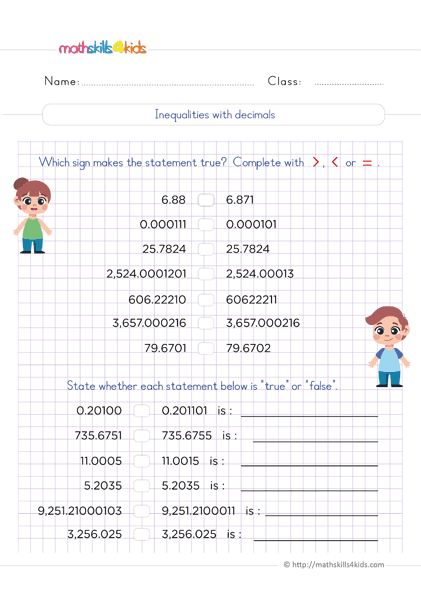
Say what your child did: "You checked the first different digit every time." The next sheet, inequalities with decimals, asks the same question two numbers at a time, with signs instead of lists.
About this 6th Grade decimals worksheet
Download the worksheet: Putting decimal numbers in orders
Download the PDF (opens in a new tab)Free · 2 pages · 837 KB · answer key included
🍪 Free worksheets are paid for by ads
To download for free, please accept cookies, or go Premium for an ad-free experience.
A few related activities
Inequalities with decimals
Printable PDF: 6th Grade decimals practice, 2 pages, answer key included.
See the activity: Inequalities with decimalsRounding decimals
Printable PDF: 6th Grade decimals practice, 2 pages, answer key included.
See the activity: Rounding decimalsHow to place decimals on the number line practice
Printable PDF: 6th Grade decimals practice, 2 pages, answer key included.
See the activity: How to place decimals on the number line practiceWhich decimal number is illustrated practice
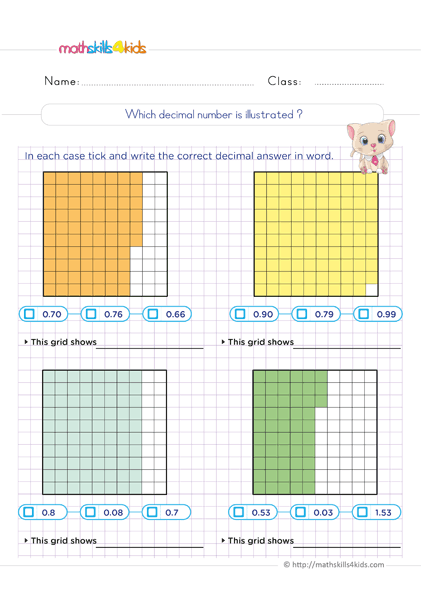
Printable PDF: 6th Grade decimals practice, 1 page.
See the activity: Which decimal number is illustrated practiceReading and writing decimals in words practice
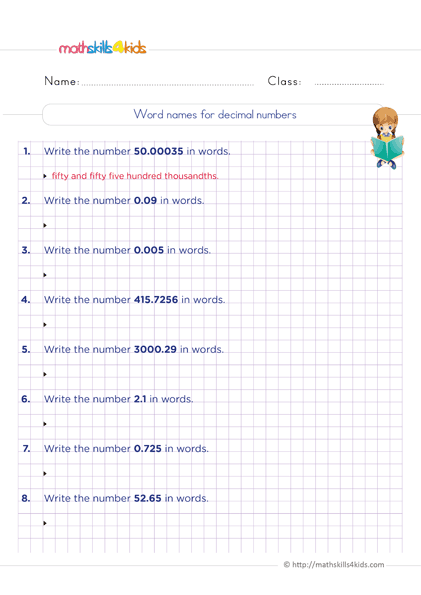
Printable PDF: 6th Grade decimals practice, 2 pages, answer key included.
See the activity: Reading and writing decimals in words practiceThe place value of digits in whole numbers
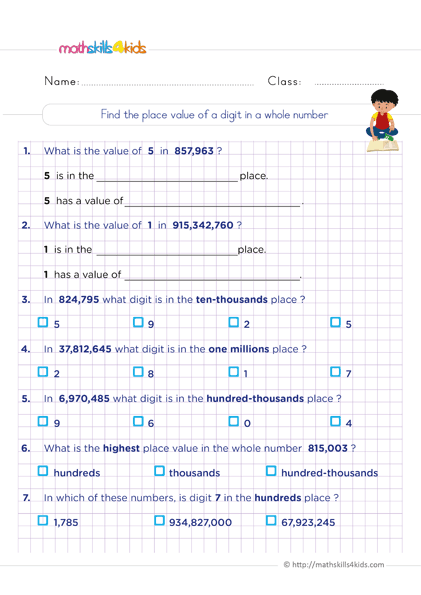
Printable PDF: 6th Grade whole numbers practice, 2 pages, answer key included.
See the activity: The place value of digits in whole numbers