Solving inequalities with decimals
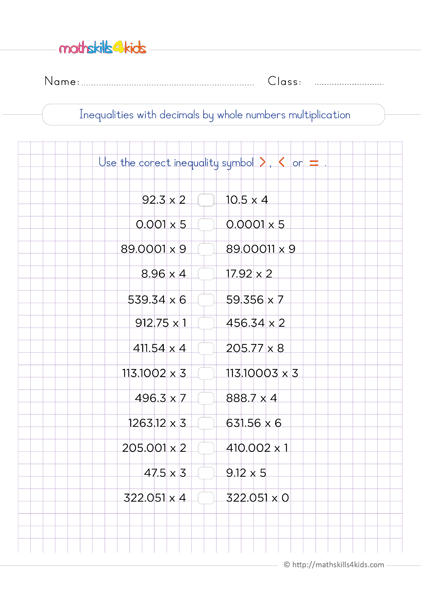
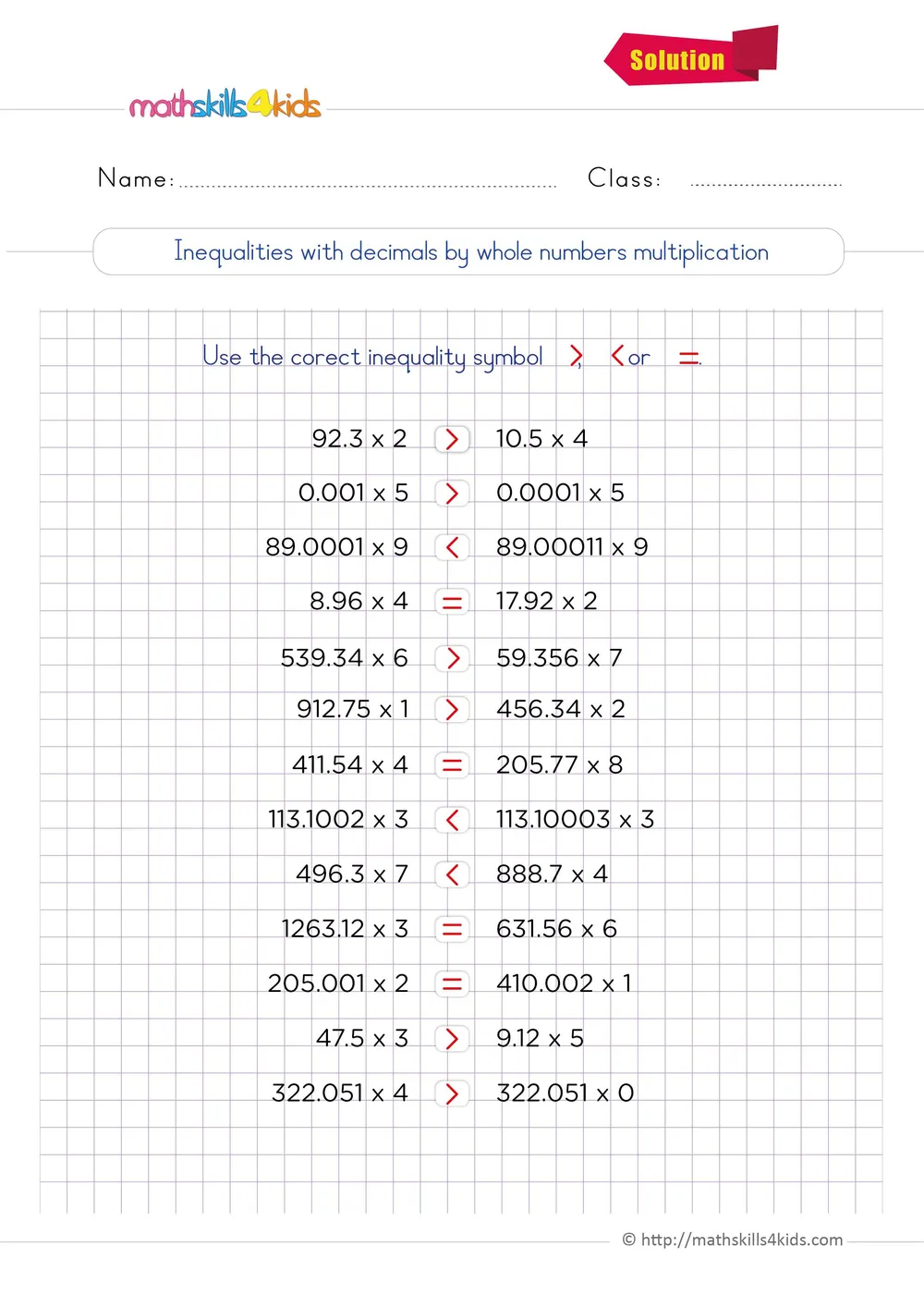
Long decimals can fool the eye: 113.10003 looks bigger than 113.1002 because it has more digits. It is not. Here your child works through thirteen comparisons, multiplying each side by a whole number before choosing greater than, less than, or equal. That is practice comparing decimal products with inequality symbols, and four rows turn out exactly equal. Page 2 has the answer key, with one sign corrected below.
The case of the longer number
Comparing decimals is a place-value job: line up the points and read from the left until two digits differ. Here each side is a product, so your child multiplies first, then compares, and a few rows can be judged without multiplying at all.
Look at rows 3 and 8. Both sides are multiplied by the same number, 9 or 3, so only 89.0001 against 89.00011 and 113.1002 against 113.10003 matter. Four rows come out equal, like 8.96 × 4 and 17.92 × 2, which rewards spotting equal products by doubling and halving.
The standards are 6.NS.B.3 for the multiplication and 6.NS.C.7, ordering rational numbers, for the comparison.
Even the key fell for it
Row 8 is the one to read aloud. Have your child point to each digit after the point, one place at a time. "Where do the two numbers first differ?" At the fourth place, a 2 against a 0.
The likely slip is exactly what the page tests: more digits look like a bigger number. Row 13 holds a gentler surprise. "What does any number times 0 make?"
A note for parents on row 8: the answer page shows less than, but 113.1002 × 3 = 339.3006 is greater than 113.10003 × 3 = 339.30009. The correct sign is greater than. Let your child find it; catching a mistake in a key is real proof of understanding.
Which deal is bigger?
Two packs of the same juice make a ready-made comparison: 3 bottles at $1.25 against 2 bottles at $1.80. Ask your child for the sign before anyone multiplies, then check.
After a run or a bike ride, compare two weeks as products: 2 rides of 1.6 miles against 3 rides of 1.05 miles.
In a game of Monopoly, before paying, compare two choices as products, such as three rents of $22 against two of $35, and say the sign out loud.
If your child caught row 8, say so: "You trusted place value over length." The next topic moves to fractions, starting with placing fractions on a number line.
About this 6th Grade multiply & divide decimals worksheet
Download the worksheet: Solving inequalities with decimals
Download the PDF (opens in a new tab)Free · 2 pages · 725 KB · answer key included
🍪 Free worksheets are paid for by ads
To download for free, please accept cookies, or go Premium for an ad-free experience.
A few related activities
Multiplying decimals
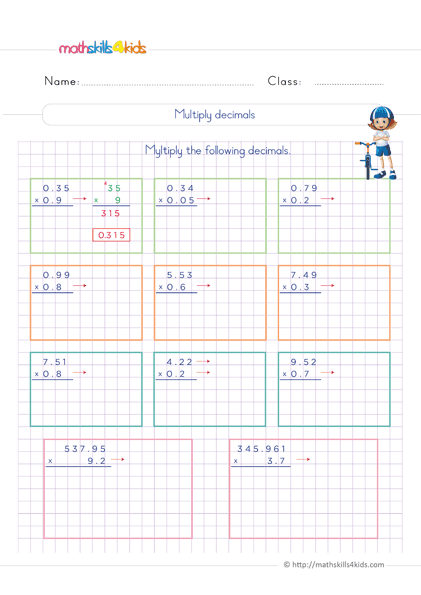
Printable PDF: 6th Grade multiply & divide decimals practice, 2 pages, answer key included.
See the activity: Multiplying decimalsDivide with decimal quotient
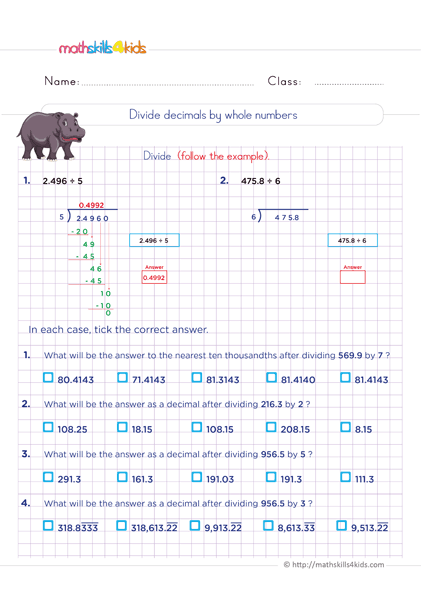
Printable PDF: 6th Grade multiply & divide decimals practice, 2 pages, answer key included.
See the activity: Divide with decimal quotientDivide decimals by whole numbers word problems
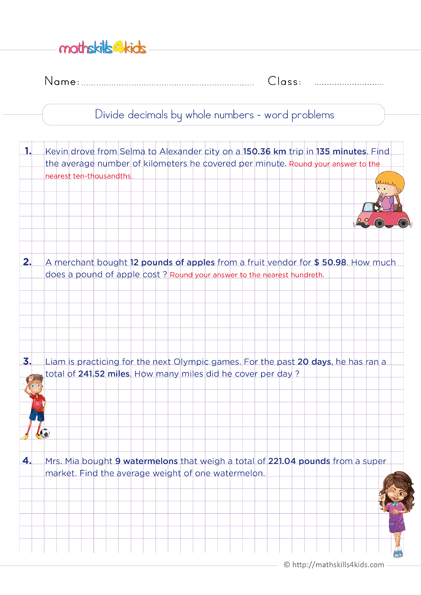
Printable PDF: 6th Grade multiply & divide decimals practice, 2 pages, answer key included.
See the activity: Divide decimals by whole numbers word problemsDividing decimals by power of ten
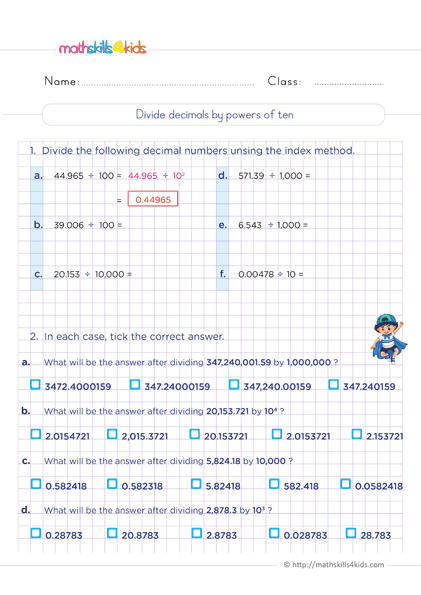
Printable PDF: 6th Grade multiply & divide decimals practice, 2 pages, answer key included.
See the activity: Dividing decimals by power of tenHow to divide with decimal quotient
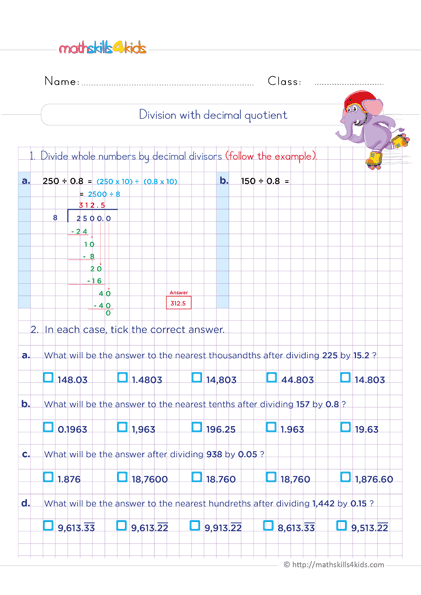
Printable PDF: 6th Grade multiply & divide decimals practice, 2 pages, answer key included.
See the activity: How to divide with decimal quotientThe place value of digits in whole numbers
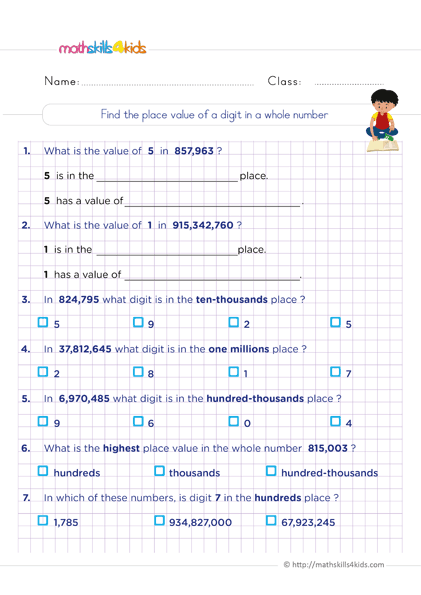
Printable PDF: 6th Grade whole numbers practice, 2 pages, answer key included.
See the activity: The place value of digits in whole numbers