Estimating products of fractions & whole numbers
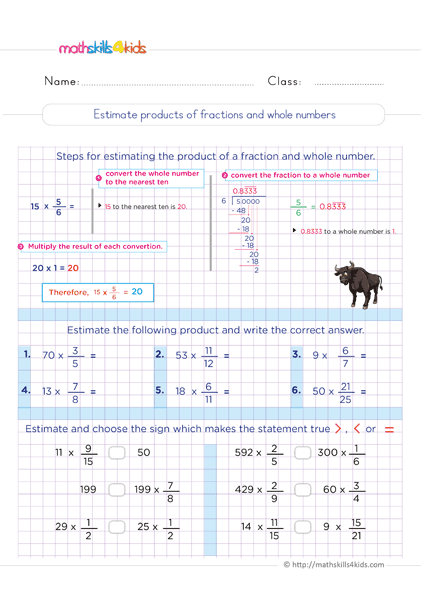
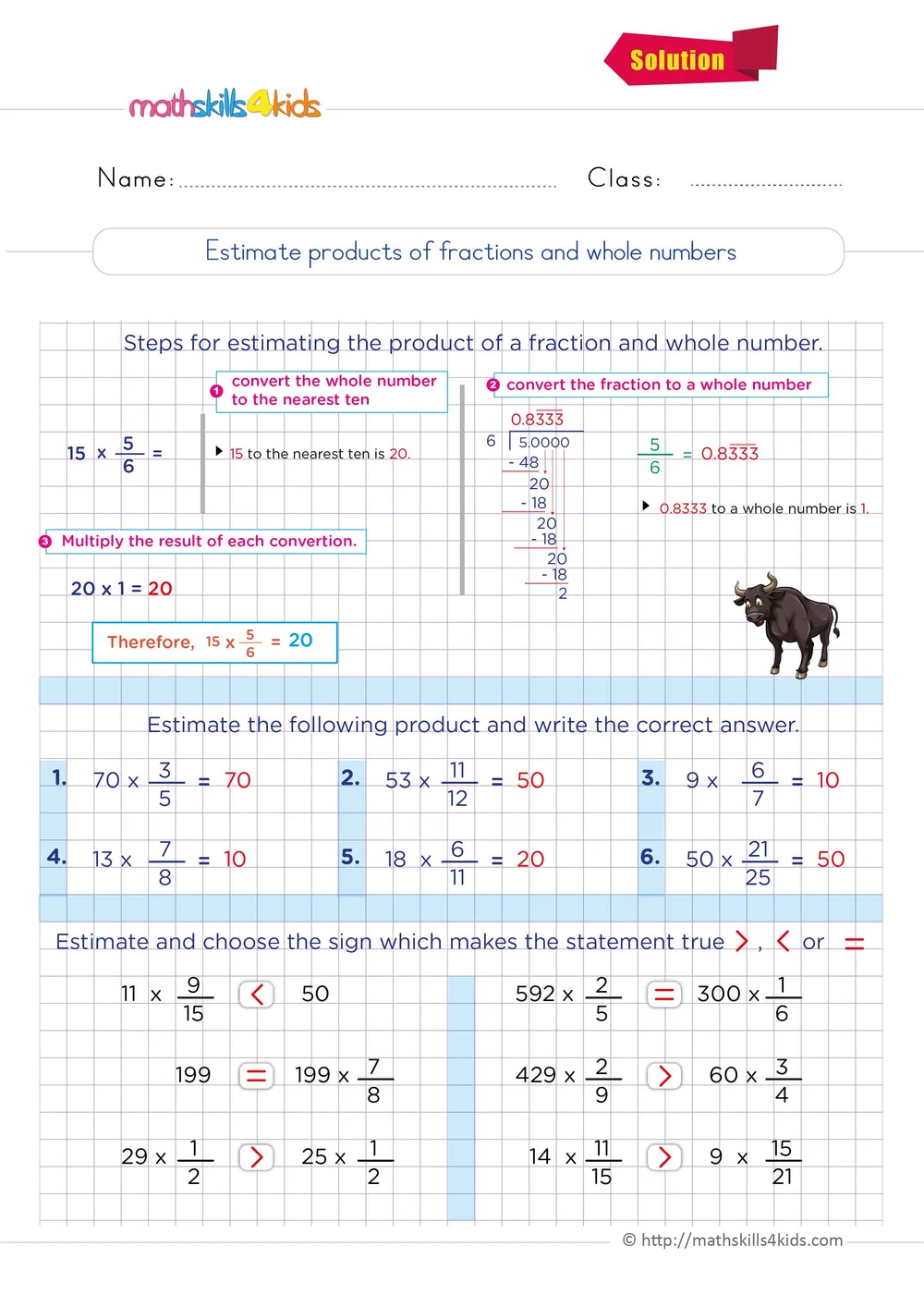
An estimate of 70 for a product that is really 42 still counts as correct on this page. That paradox is the lesson: the method rounds the whole number to the nearest ten and the fraction to 0 or 1, and your child learns where estimating products of fractions and whole numbers that way helps and where it misleads. Six products to estimate follow a worked example, then six comparisons ask for greater than, less than or equal. Page 2 has the answers.
Can 3/5 really round to 1?
A three-step routine runs the whole page, shown on 15 × 5/6: round 15 to 20, round 5/6 to the whole number 1, multiply. The long division that turns 5/6 into 0.8333 is printed right inside the example.
The routine is quick. It works well when the fraction sits near 1, like 21/25 or 11/12. It drifts when the fraction sits near 1/2: 70 × 3/5 becomes 70, though the true product is 42. A sharper benchmark, rounding to 0, 1/2 or 1, would give 35.
Comparing a product with its factors without computing it is 5.NF.B.5.a, and the bottom half of the page practices exactly that.
When both sides round to nothing
Look hard at 592 × 2/5 against 300 × 1/6. Rounded the page's way, both fractions become 0, so both sides become 0. Ask, "Is 2/5 of 592 really nothing?" It is more than 200.
Parent note: the answer page marks that comparison as equal, and 199 against 199 × 7/8 too. The exact values are 236 4/5 against 50, and 199 against 174 1/8, so greater than is the true sign in both. The other four signs on the key match the exact products.
Have your child say which side holds the bigger fraction before choosing any sign, then check one pair by multiplying.
How close is close enough?
Estimation earns its keep at the store. A $49 jacket sells at 3/4 of the price: round to $50, and 3/4 of $50 is $37.50, close to the $36.75 on the receipt.
Fuel is another. A 13-gallon tank showing 7/8 full holds about 11 gallons, the same 13 × 7/8 as problem 4, and your child can check it from the passenger seat.
How Much Is a Million? by David M. Schwartz makes huge numbers feel real; read a page and estimate along with it.
Credit the judgment call: "You noticed the rule went too far, and you checked." Multiplying two fractions with area models is next.
About this 6th Grade multiply fractions worksheet
Download the worksheet: Estimating products of fractions & whole numbers
Download the PDF (opens in a new tab)Free · 2 pages · 862 KB · answer key included
🍪 Free worksheets are paid for by ads
To download for free, please accept cookies, or go Premium for an ad-free experience.
A few related activities
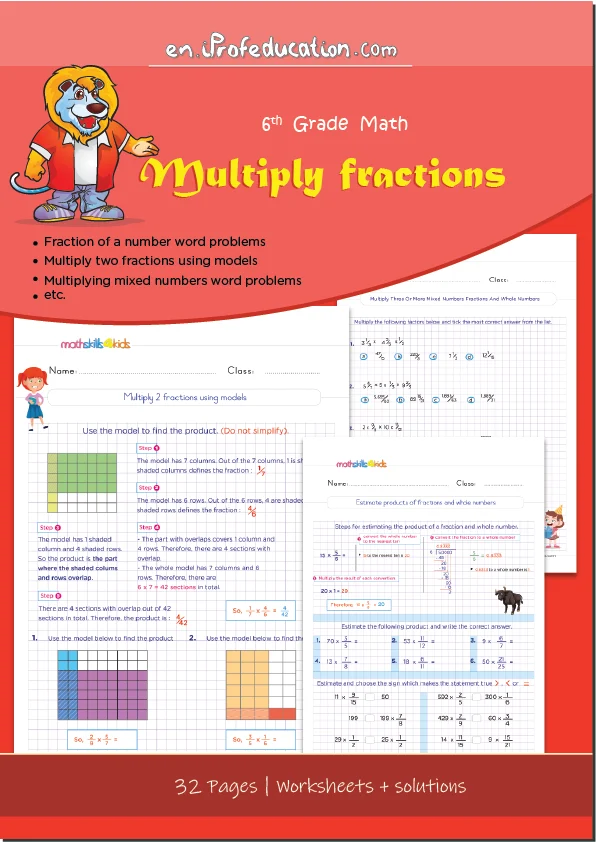
Multiplying two fractions using models
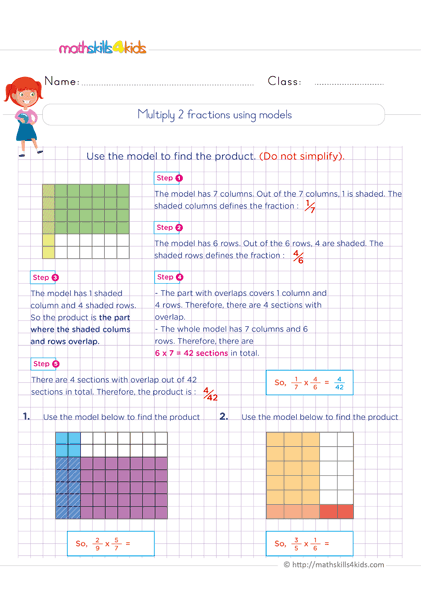
Printable PDF: 6th Grade multiply fractions practice, 4 pages, answer key included.
See the activity: Multiplying two fractions using modelsMultiplication of fractions word problems
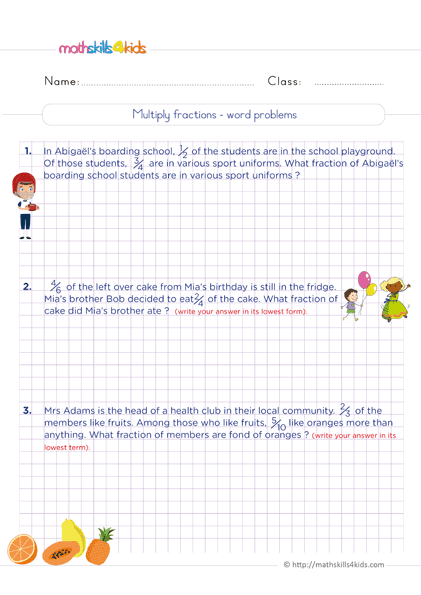
Printable PDF: 6th Grade multiply fractions practice, 2 pages, answer key included.
See the activity: Multiplication of fractions word problemsMultiply three or more fractions and whole numbers
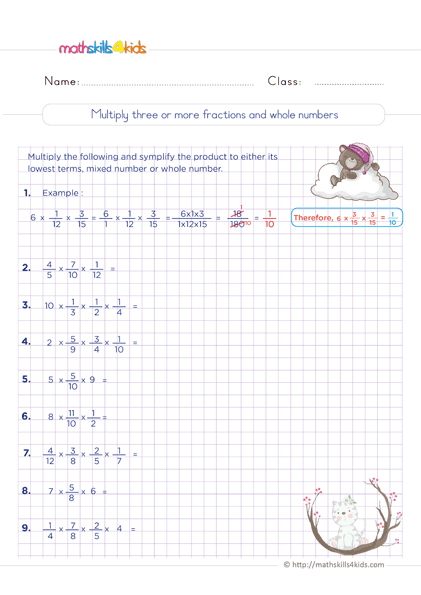
Printable PDF: 6th Grade multiply fractions practice, 2 pages, answer key included.
See the activity: Multiply three or more fractions and whole numbersFractions of whole number exercises
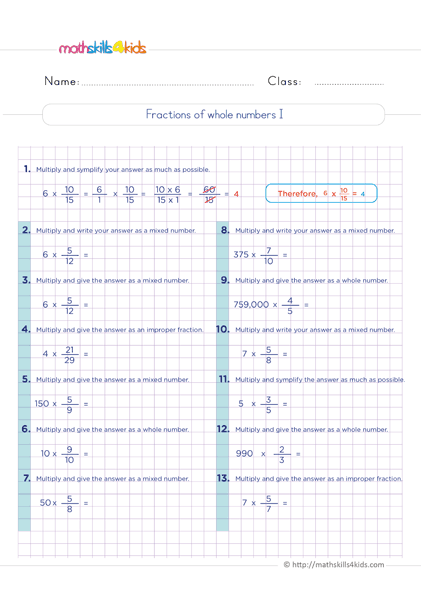
Printable PDF: 6th Grade multiply fractions practice, 2 pages, answer key included.
See the activity: Fractions of whole number exercisesFinding fractions of whole numbers
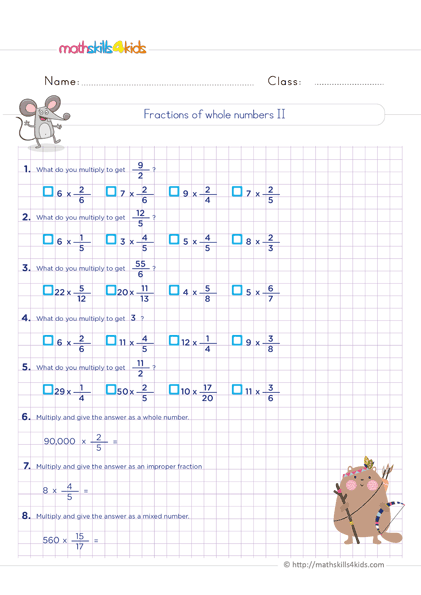
Printable PDF: 6th Grade multiply fractions practice, 2 pages, answer key included.
See the activity: Finding fractions of whole numbersThe place value of digits in whole numbers
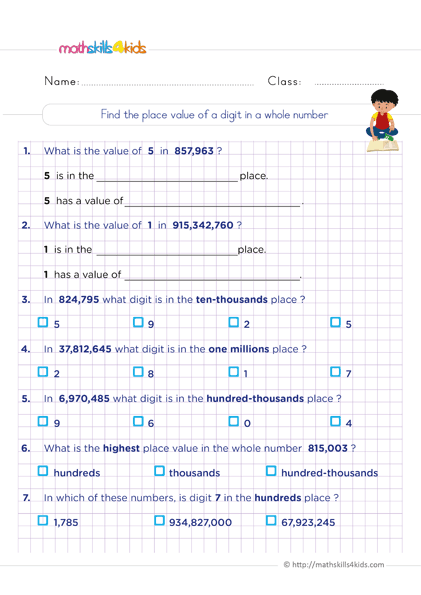
Printable PDF: 6th Grade whole numbers practice, 2 pages, answer key included.
See the activity: The place value of digits in whole numbers