Finding fractions of whole numbers
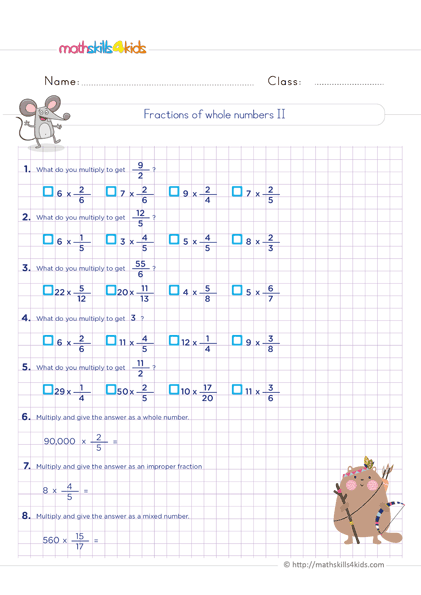
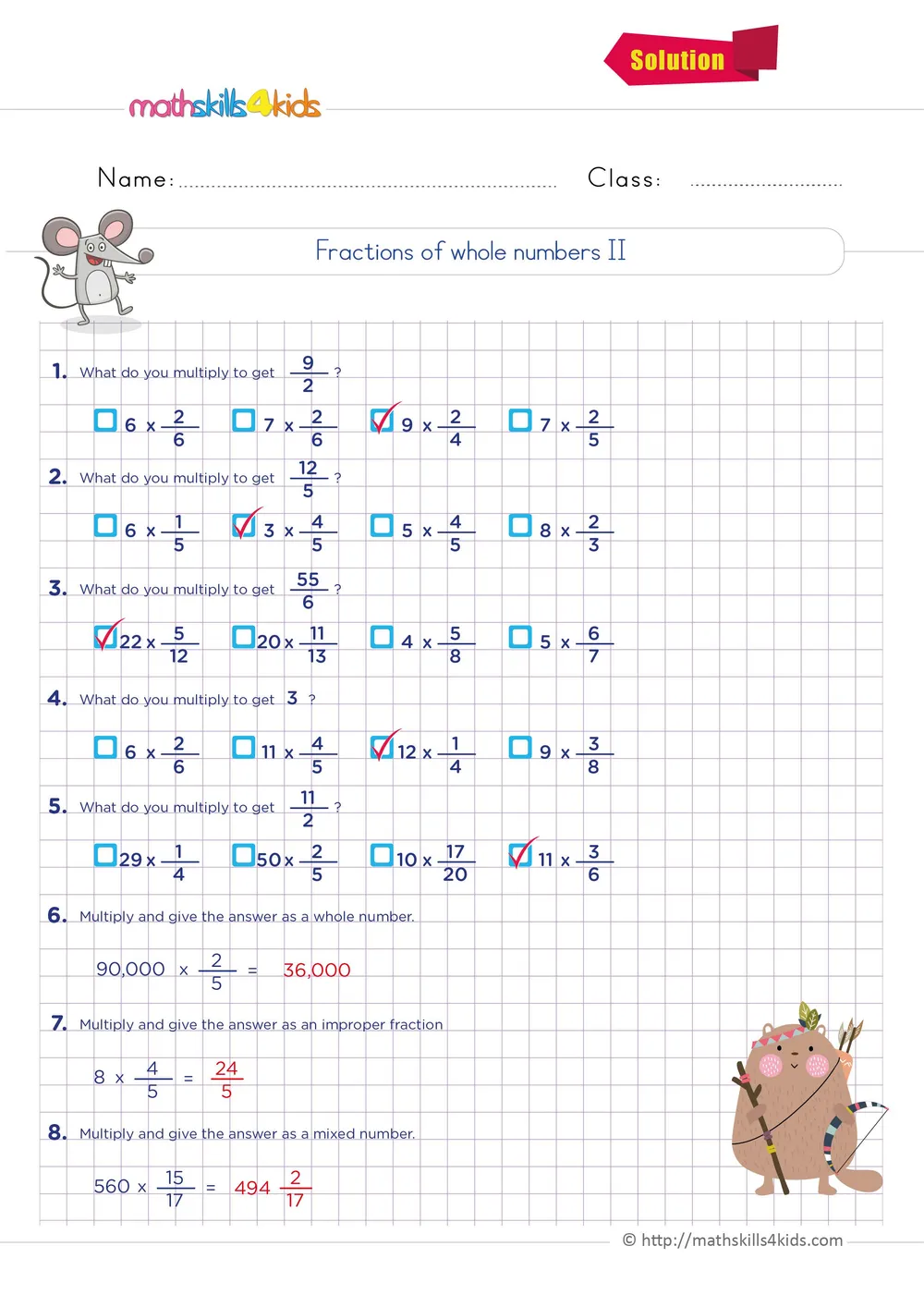
Which of four products lands exactly on 9/2? Your child turns detective here, testing each option until one matches, which makes finding fractions of whole numbers a search instead of a drill. Five multiple-choice targets come first, one of them the whole number 3, and then three straight products ask for a whole number, an improper fraction and a mixed number. The answer key on page 2 marks every right box.
Why test every box?
Each target is a product in disguise. Nine halves could come from 9 × 2/4, from 3 × 3/2, from many pairs, and the page offers four candidates with one true match. Working backward like this builds the habit of seeing a whole number times a fraction as a count of unit pieces: 9 × 2/4 is eighteen quarters, and eighteen quarters make nine halves.
The decoys are not random. In question 4, 11 × 4/5 and 9 × 3/8 both look close to 3 until they are multiplied out.
This page works on 5.NF.B.4.a, a fraction times a whole number, and on 4.NF.B.4.b, a multiple of a/b seen as a multiple of 1/b.
One answer on the key needs a second look
The decoys get sneaky in question 3. The target 55/6 shares a 5 with three of the options, so a quick eye may grab 4 × 5/8. Ask, "What do you get if you actually multiply it?" Only one works. 22 × 5/12 reaches 110/12, which simplifies to 55/6.
Problem 8 is the long one: 560 × 15/17 gives 8,400/17, and dividing by 17 leaves 494 2/17.
For parents checking the work: the answer page shows 24/5 for problem 7, but 8 × 4/5 is 32/5. If your child writes 32/5, they are right; say so plainly, then ask, "Where could 24 have come from?"
Make 24, then make 9/2
Players of the 24 Game get four numbers and hunt for a way to reach 24; this page runs the same search with fractions. Turn it into a kitchen game. You name a target like 3 cups, and your child names a whole number and a fraction that make it, such as 12 × 1/4 cup or 6 × 1/2 cup.
Allowance works too. If a $20 allowance gets split and 2/5 goes to savings, how much is saved? Eight dollars.
Point out the checking: "You multiplied every option before you ticked one." Estimating products of fractions and whole numbers comes next.
About this 6th Grade multiply fractions worksheet
Download the worksheet: Finding fractions of whole numbers
Download the PDF (opens in a new tab)Free · 2 pages · 778 KB · answer key included
🍪 Free worksheets are paid for by ads
To download for free, please accept cookies, or go Premium for an ad-free experience.
A few related activities
Estimating products of fractions & whole numbers
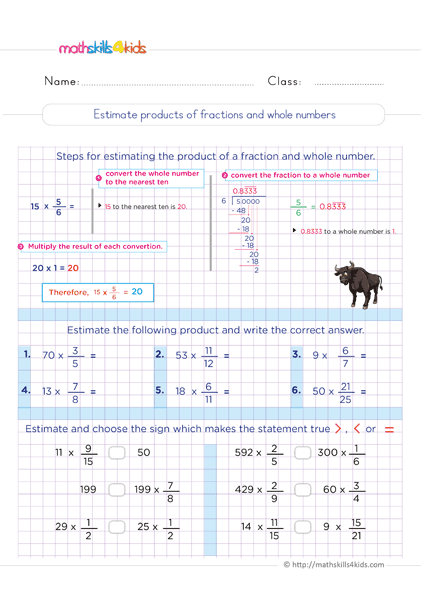
Printable PDF: 6th Grade multiply fractions practice, 2 pages, answer key included.
See the activity: Estimating products of fractions & whole numbersMultiplying two fractions using models
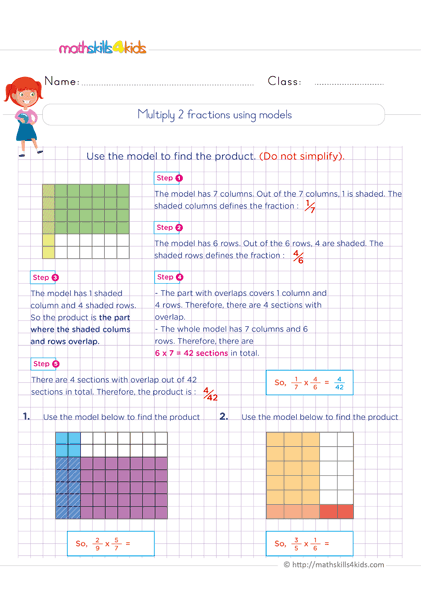
Printable PDF: 6th Grade multiply fractions practice, 4 pages, answer key included.
See the activity: Multiplying two fractions using modelsMultiplication of fractions word problems
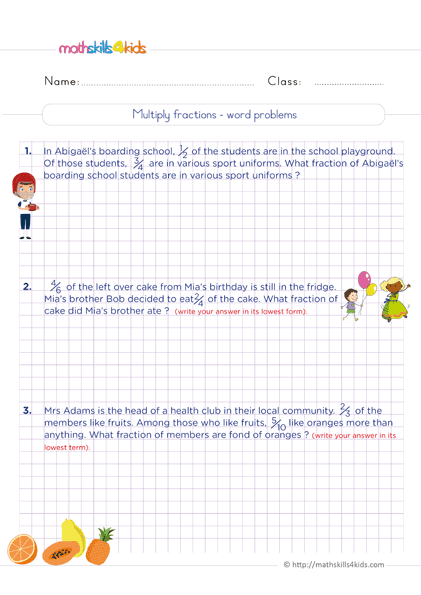
Printable PDF: 6th Grade multiply fractions practice, 2 pages, answer key included.
See the activity: Multiplication of fractions word problemsMultiply three or more fractions and whole numbers
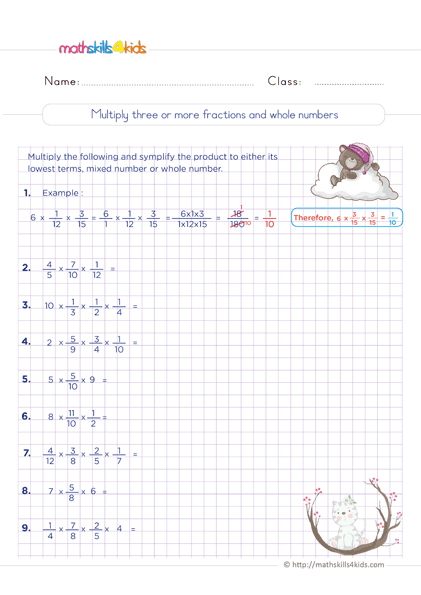
Printable PDF: 6th Grade multiply fractions practice, 2 pages, answer key included.
See the activity: Multiply three or more fractions and whole numbersFractions of whole number exercises
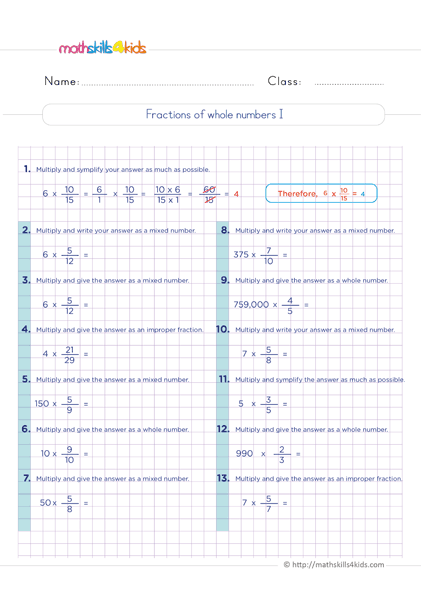
Printable PDF: 6th Grade multiply fractions practice, 2 pages, answer key included.
See the activity: Fractions of whole number exercisesThe place value of digits in whole numbers
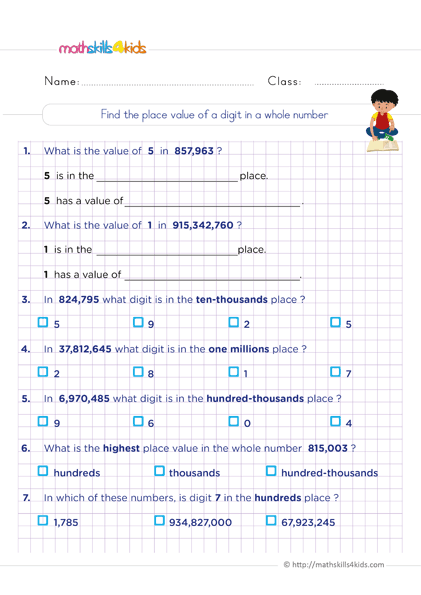
Printable PDF: 6th Grade whole numbers practice, 2 pages, answer key included.
See the activity: The place value of digits in whole numbers