Adding and subtracting mixed numbers
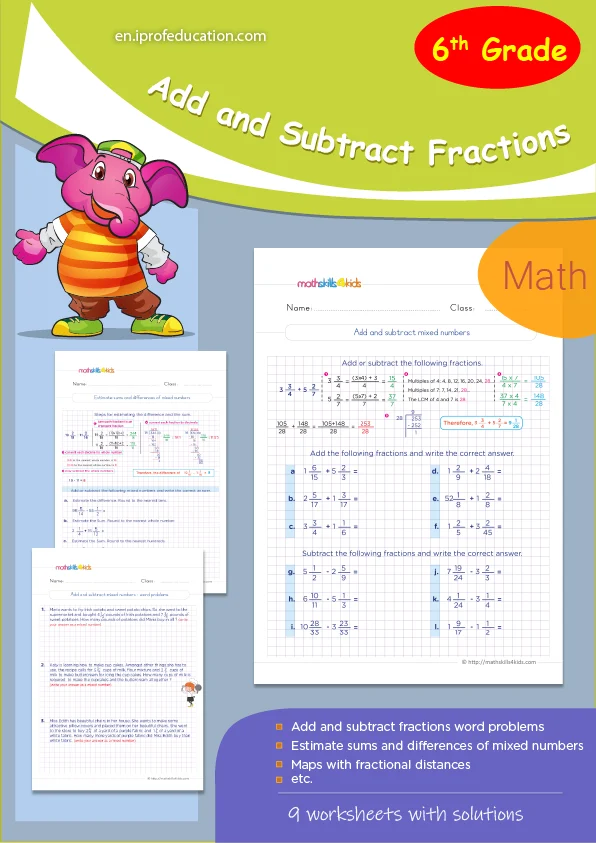
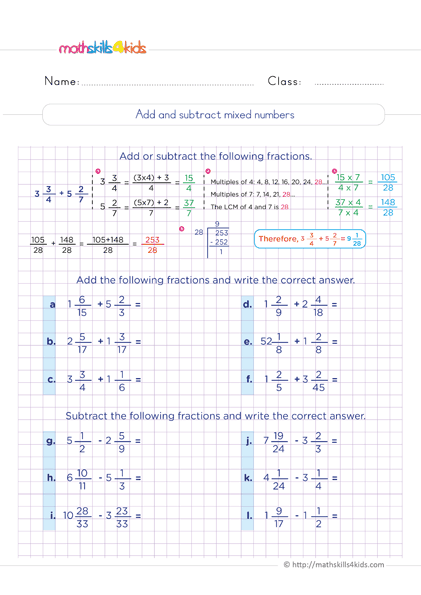
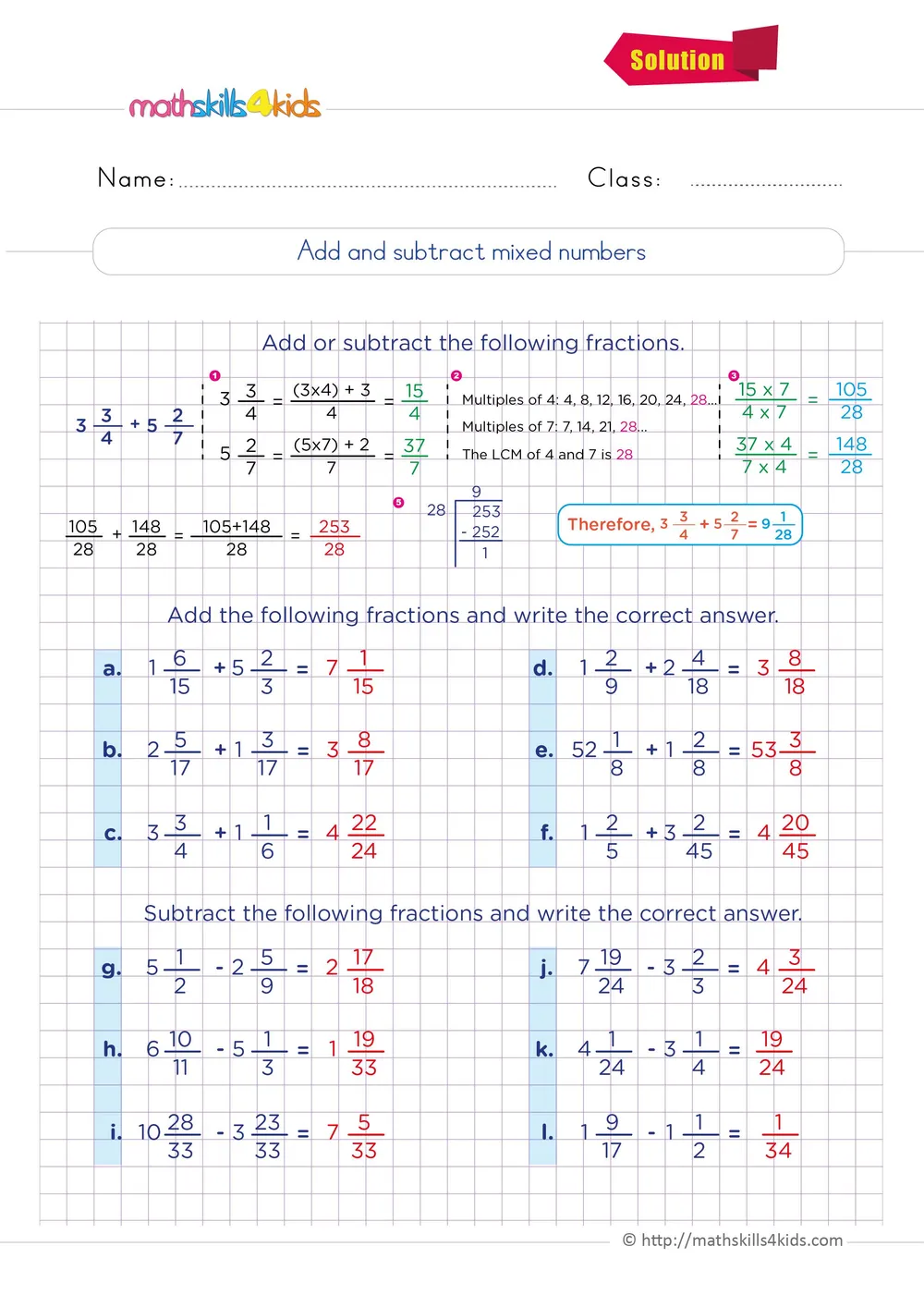
Taking 2 5/9 away from 5 1/2 looks impossible at first, since 1/2 is smaller than 5/9, yet the answer is a comfortable 2 17/18. The page opens with 3 3/4 + 5 2/7 worked step by step through improper fractions and an LCM of 28. Six sums and six differences follow, and your child practices adding and subtracting mixed numbers with regrouping whenever a fraction part runs short or spills past one. Page 2 is the answer key.
Two roads to the same answer
Every mixed number carries two parts: a whole number and a fraction. To add or subtract them, there are two honest routes. Turn both into improper fractions, as the worked example does with 15/4 and 37/7, or handle wholes and fractions separately and regroup at the end.
Both routes earn their place in the rows. Problem e, 52 1/8 + 1 2/8, would be clumsy as 417/8 plus 10/8, while working in parts gives 53 3/8 in seconds. Problem g, by contrast, needs a whole broken into eighteenths before the fractions can be subtracted.
The standards are 5.NF.A.1, which includes mixed numbers with unlike denominators, and 4.NF.B.3.c for rows like b and i, where the denominators already match.
Borrowing a whole, not a ten
Problem g is where the conversation happens. Your child sees 5 1/2 - 2 5/9, rewrites the fractions as 9/18 and 10/18, and stops. "I can't take 10 from 9." Answer with a question: "What if one of the 5 wholes became eighteenths?"
That is the moment to watch. Many children borrow a ten out of habit from whole-number subtraction and write 19/18. A whole is 18/18 here, so 9/18 becomes 27/18 and the 5 becomes 4. Then 27/18 - 10/18 = 17/18, and 4 - 2 = 2.
A note for parents: the answer key leaves four answers unsimplified, 4 22/24, 3 8/18, 4 20/45 and 4 3/24. Accept 4 11/12, 3 4/9, 4 4/9 and 4 1/8 too.
Recipes double, boards get cut
Mixed numbers live in the kitchen. A recipe calling for 1 1/2 cups of milk plus another 2 3/4 cups means 4 1/4 cups in the pitcher; let your child predict before pouring.
In the garage or craft corner, plan on paper to cut 2 5/8 feet off a 6 1/4 foot board. The regrouping from problem g shows up again, because 1/4 is smaller than 5/8.
The Grapes of Math by Greg Tang trains children to group numbers cleverly before counting, the same instinct that adds wholes first and fractions second.
Close with the effort: "You broke a whole when you ran short, and it worked." Word problems with mixed numbers are next.
About this 6th Grade add & subtract fractions worksheet
Download the worksheet: Adding and subtracting mixed numbers
Download the PDF (opens in a new tab)Free · 2 pages · 831 KB · answer key included
🍪 Free worksheets are paid for by ads
To download for free, please accept cookies, or go Premium for an ad-free experience.
A few related activities
Add and subtract mixed numbers word problems
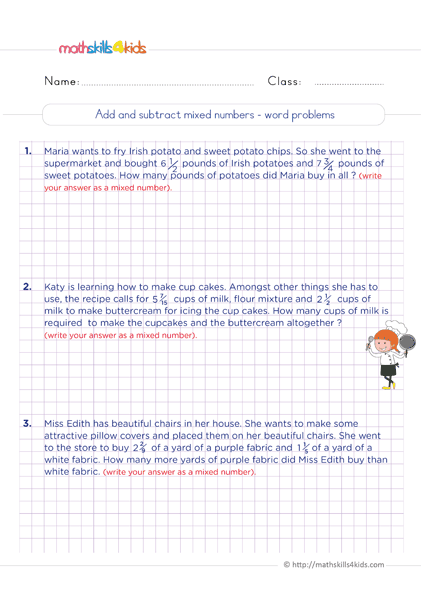
Printable PDF: 6th Grade add & subtract fractions practice, 2 pages, answer key included.
See the activity: Add and subtract mixed numbers word problemsHow to estimate sums and differences of mixed numbers
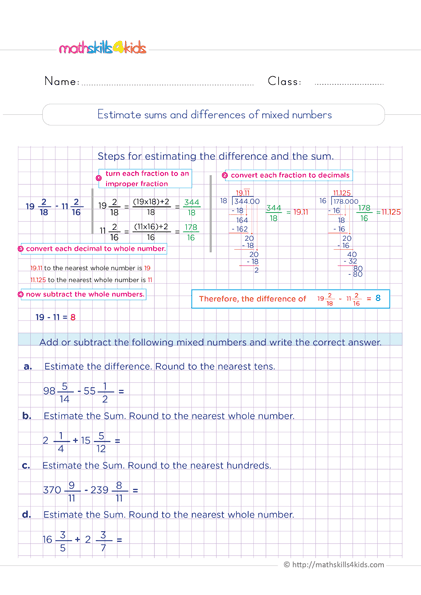
Printable PDF: 6th Grade add & subtract fractions practice, 2 pages, answer key included.
See the activity: How to estimate sums and differences of mixed numbersAdding and subtracting fractions with same denominator
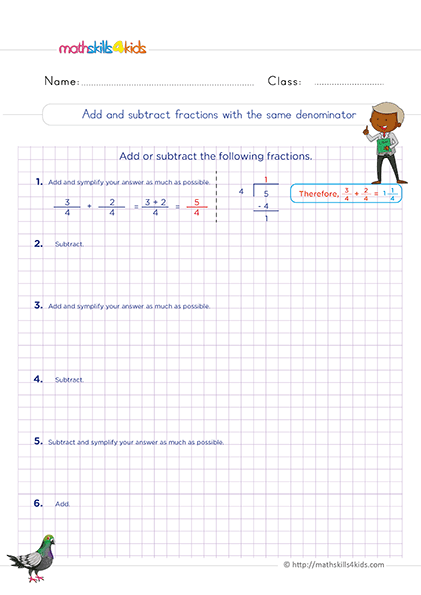
Printable PDF: 6th Grade add & subtract fractions practice, 2 pages, answer key included.
See the activity: Adding and subtracting fractions with same denominatorAdd and subtract fractions with unlike denominators
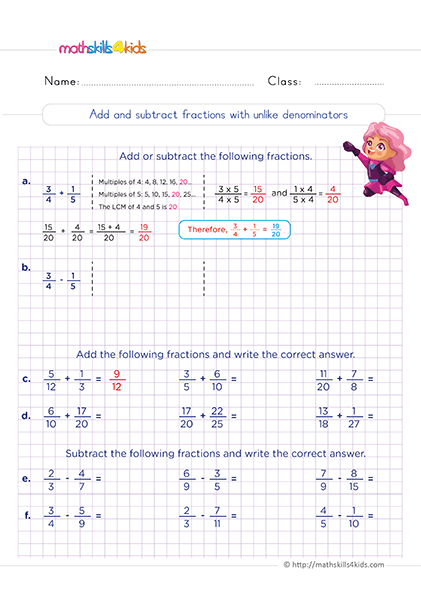
Printable PDF: 6th Grade add & subtract fractions practice, 2 pages, answer key included.
See the activity: Add and subtract fractions with unlike denominatorsAdding and subtracting unlike fractions word problems
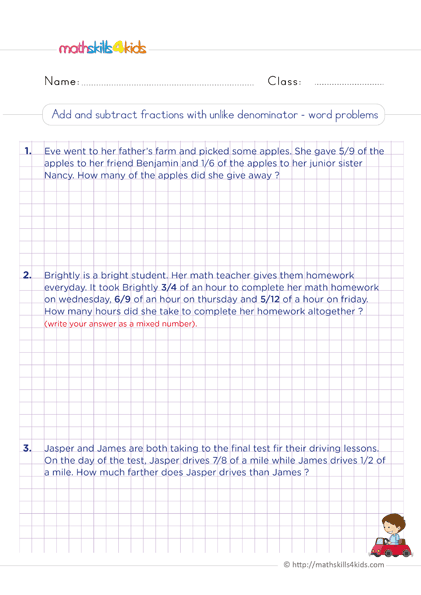
Printable PDF: 6th Grade add & subtract fractions practice, 2 pages, answer key included.
See the activity: Adding and subtracting unlike fractions word problemsThe place value of digits in whole numbers
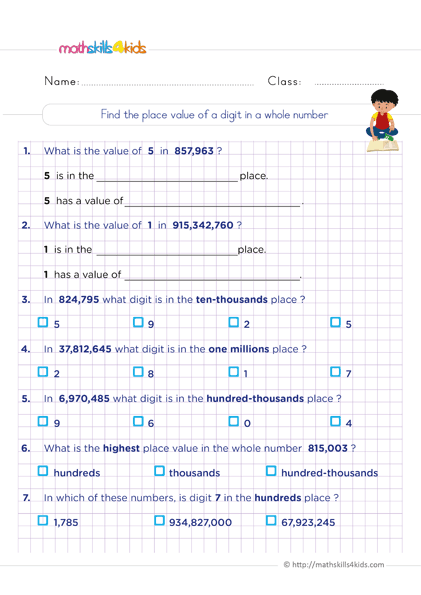
Printable PDF: 6th Grade whole numbers practice, 2 pages, answer key included.
See the activity: The place value of digits in whole numbers