How to estimate sums and differences of mixed numbers
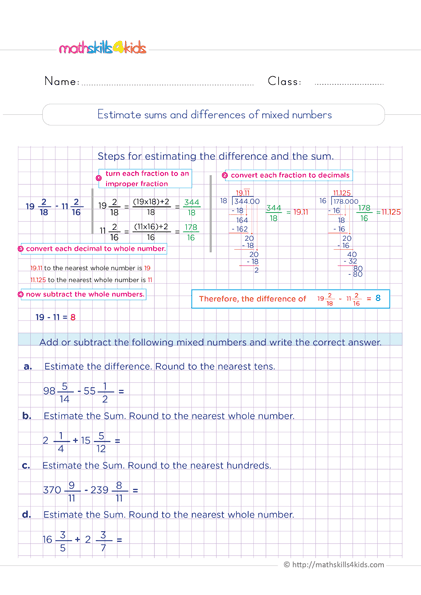
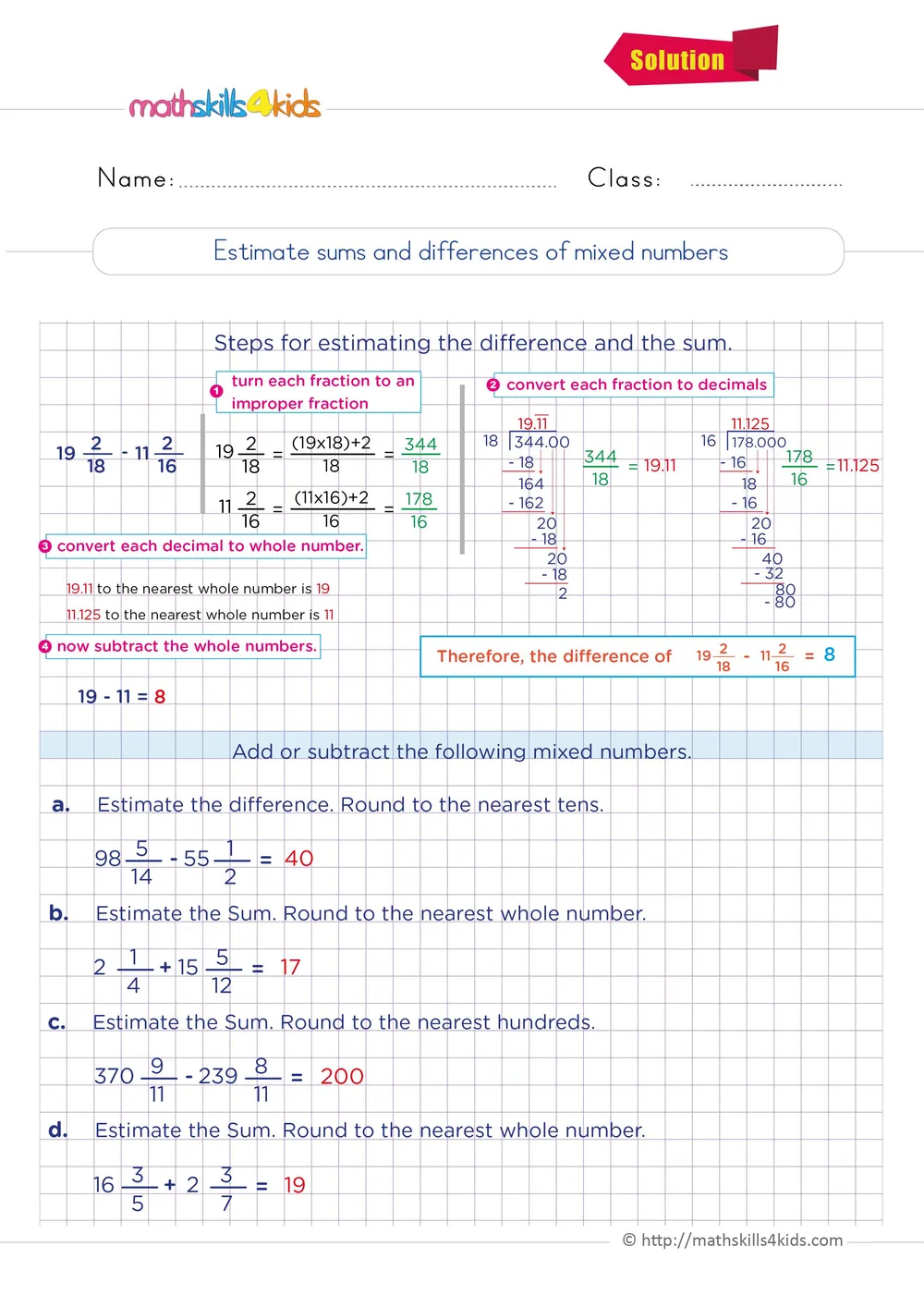
Imagine your child checking a fraction answer in five seconds, before any long division. That is the promise of estimating mixed number sums and differences by rounding, and this page builds it step by step. A worked example rounds 19 2/18 to 19 and 11 2/16 to 11 for a difference of 8, then four problems ask for rounding to the nearest whole number, ten, or hundred. Page 2 gives the answer key.
Is 200 a good guess?
Adults check arithmetic all day without redoing it. Round each mixed number first, then add or subtract the round numbers, and any answer far from that estimate deserves a second look.
The page sets one clear rule: round every number before operating, to the place the problem names. Problem a rounds to tens, so 98 5/14 becomes 100 and 55 1/2 becomes 60, an estimate of 40 against a true 42 6/7. Its worked example takes a long road, converting fractions to decimals by long division; comparing each fraction part with 1/2 gives the same rounding faster.
The standard is 5.NF.A.2, which uses benchmark fractions to judge whether answers are reasonable. Rounding to tens and hundreds goes past that standard into place-value rounding.
When the estimate drifts far
Problem c deserves a conversation. Rounded to hundreds, 370 9/11 becomes 400 and 239 8/11 becomes 200, so the page's estimate is 200. The exact difference is about 131. Ask, "Is 200 close enough to be useful here?" Your child may decide that tens, 370 minus 240, give a much better guess.
The common slip is rounding the fraction part alone: seeing 9/11 as close to 1, writing 371, and forgetting the instruction to round to hundreds. Have your child circle the rounding place in each instruction before starting.
A note for parents on problem c: it says Estimate the Sum, but the sign is a minus, and the answer of 200 is a difference. The other answers, 40, 17 and 19, follow the page's rule.
Round the cart before checkout
Groceries make the best estimation drill. Round each price in the cart to the nearest dollar and keep a running total in your head; compare it with the receipt at checkout.
In the kitchen, a recipe that needs 2 3/4 cups of flour and 1 1/3 cups of sugar is about 3 + 1, so a bowl that holds four cups is a fair guess.
How Much Is a Million? by David M. Schwartz shows estimation at an enormous scale, and children enjoy checking whether its guesses sound reasonable.
End on what your child did well: "You estimated first, then trusted your answer." Next topic in the series: multiplying fractions.
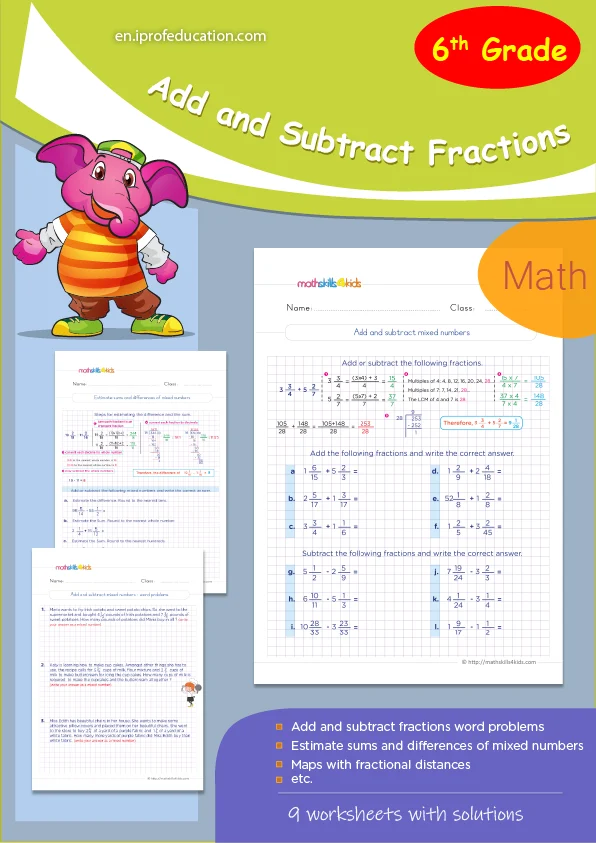
About this 6th Grade add & subtract fractions worksheet
Download the worksheet: How to estimate sums and differences of mixed numbers
Download the PDF (opens in a new tab)Free · 2 pages · 909 KB · answer key included
🍪 Free worksheets are paid for by ads
To download for free, please accept cookies, or go Premium for an ad-free experience.
A few related activities
Adding and subtracting fractions with same denominator
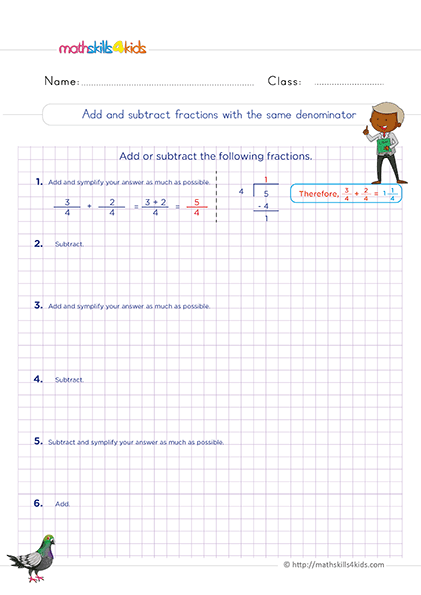
Printable PDF: 6th Grade add & subtract fractions practice, 2 pages, answer key included.
See the activity: Adding and subtracting fractions with same denominatorAdd and subtract fractions with unlike denominators
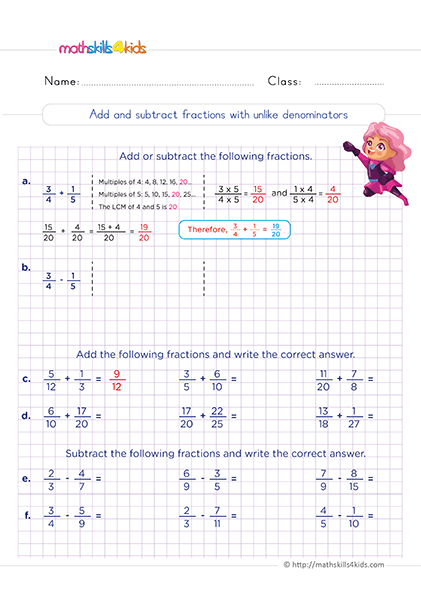
Printable PDF: 6th Grade add & subtract fractions practice, 2 pages, answer key included.
See the activity: Add and subtract fractions with unlike denominatorsAdding and subtracting unlike fractions word problems
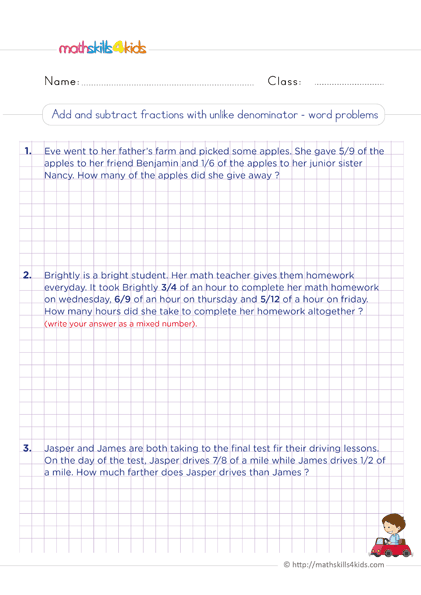
Printable PDF: 6th Grade add & subtract fractions practice, 2 pages, answer key included.
See the activity: Adding and subtracting unlike fractions word problemsAdding and subtracting mixed numbers
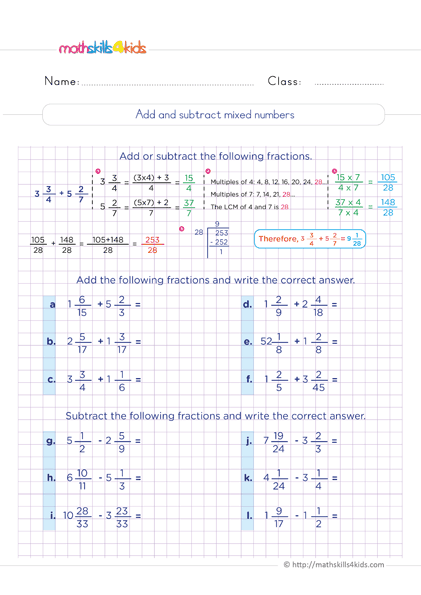
Printable PDF: 6th Grade add & subtract fractions practice, 2 pages, answer key included.
See the activity: Adding and subtracting mixed numbersAdd and subtract mixed numbers word problems
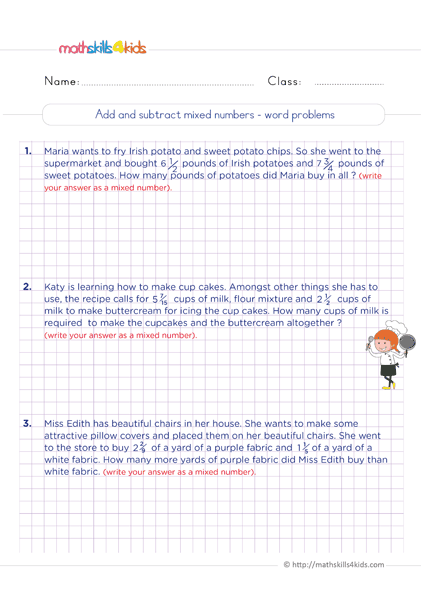
Printable PDF: 6th Grade add & subtract fractions practice, 2 pages, answer key included.
See the activity: Add and subtract mixed numbers word problemsThe place value of digits in whole numbers
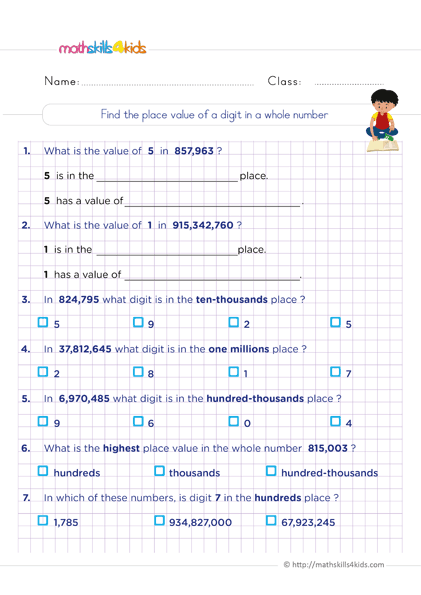
Printable PDF: 6th Grade whole numbers practice, 2 pages, answer key included.
See the activity: The place value of digits in whole numbers