Understanding fractions as division word-problems
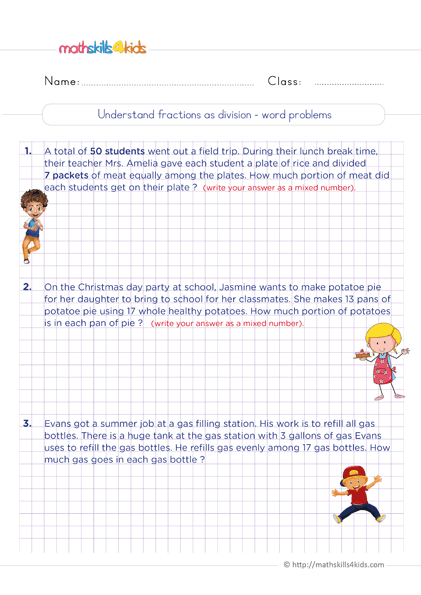
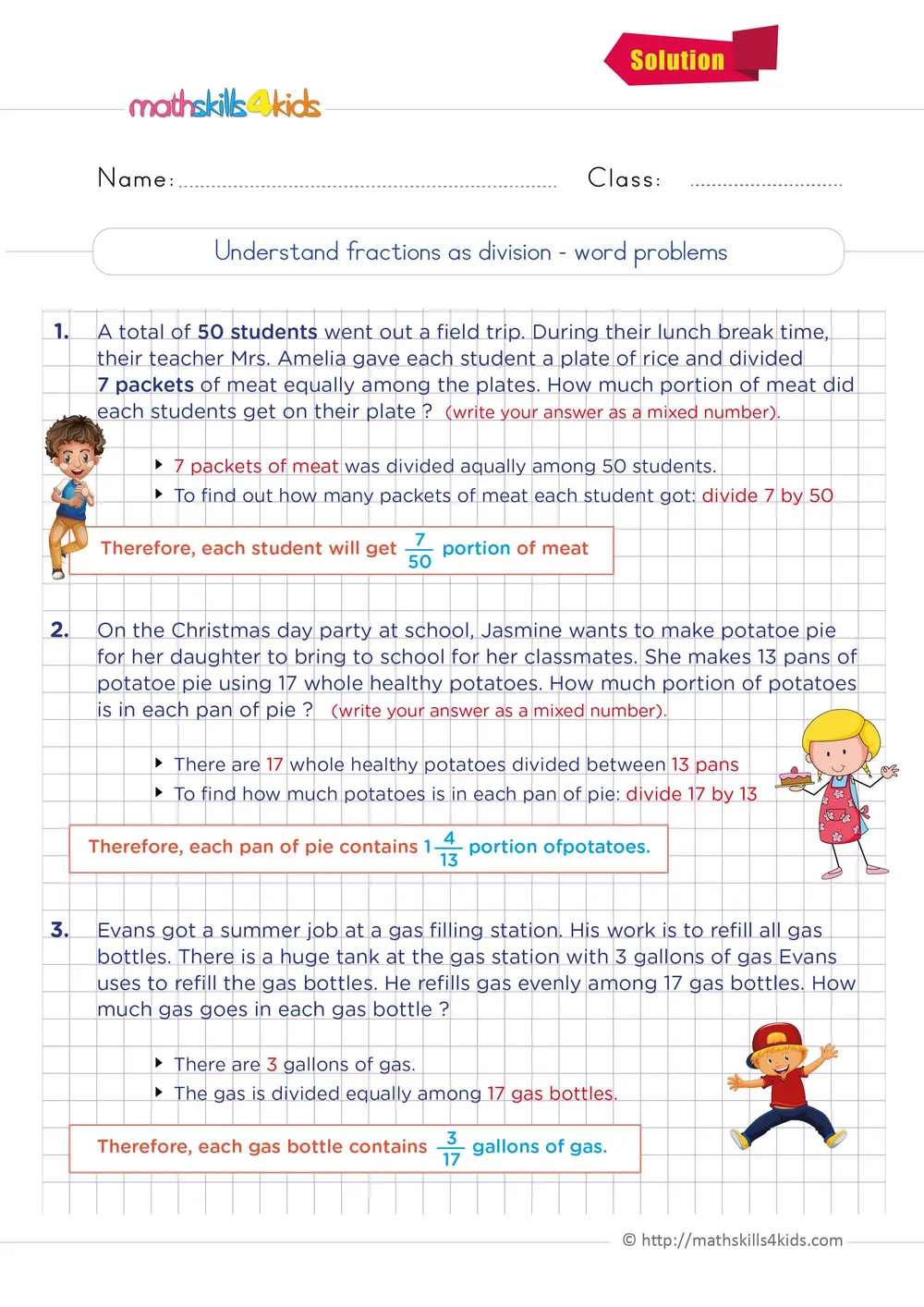
A teacher has 7 packets of meat and 50 students waiting at lunch. How much does each plate get? That field-trip story opens this page, followed by 17 potatoes shared among 13 pans of pie and 3 gallons of gas split across 17 bottles. Each time, the share is the first number over the second, and your child practices writing fractions as division in word problems, turning one answer into a mixed number. Page 2 has the answer key.
The fraction bar was a division sign all along
Children learn that 3/4 means three of four parts. Grade 5 adds a second meaning that changes a lot: 3/4 is also 3 divided by 4. Once that clicks, sharing problems stop needing long division and start producing clean answers.
The page keeps the numbers awkward on purpose. Nobody can share 7 packets among 50 plates in whole packets, so 7/50 is the honest answer. With 17 potatoes and 13 pans, each pan gets more than one potato, which is where the mixed number 1 4/13 comes from.
The standard is 5.NF.B.3, interpreting a fraction as the division of the numerator by the denominator.
Which number goes on top?
Pause on problem 2 before any writing. "What is being shared, and who gets a share?" Potatoes are shared and pans receive them, so 17 goes on top.
The classic slip is the flip: writing 13/17 because 13 appears first in the sentence. A quick check catches it. "Should each pan get more or less than one potato?" Seventeen potatoes for thirteen pans means more than one, so 13/17 cannot be right.
A note for parents on problem 1: the instructions ask for a mixed number, but 7/50 is less than one whole, so it stays a plain fraction. The answer page gives 7/50, and problems 2 and 3, 1 4/13 and 3/17, are correct.
Party math at the kitchen table
The next time leftovers need sharing, say it as a fraction. Three pizzas for four people is 3/4 of a pizza each; let your child write it before anyone cuts.
On a road trip, pour a gallon of water into the bottles in the car and name each share, such as 1/3 of a gallon.
Spaghetti and Meatballs for All! by Marilyn Burns turns a dinner party into a seating puzzle, and asking how many guests each table really gets is the question this page asks.
Praise the question that came first: "You asked who shares before you wrote the fraction." Adding and subtracting fractions is the next topic.
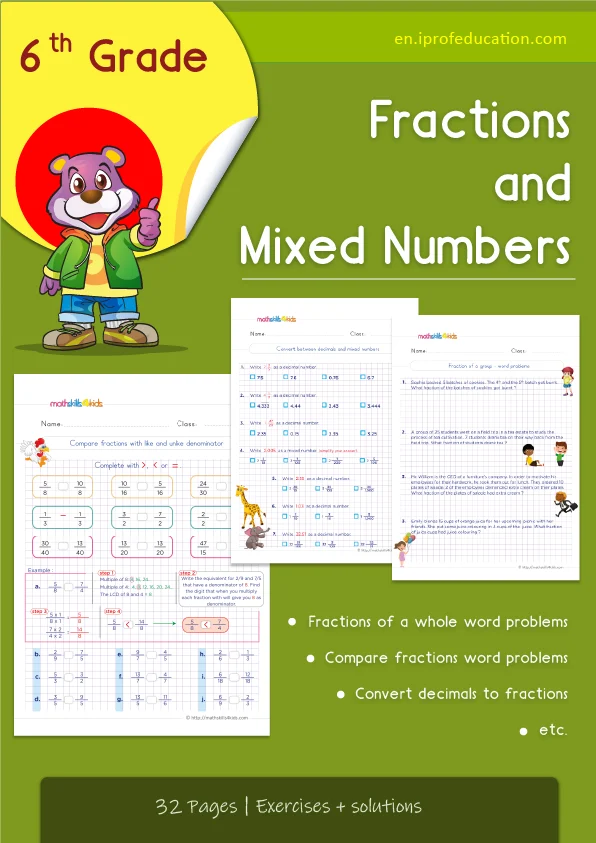
About this 6th Grade fractions & mixed numbers worksheet
Download the worksheet: Understanding fractions as division word-problems
Download the PDF (opens in a new tab)Free · 2 pages · 1 MB · answer key included
🍪 Free worksheets are paid for by ads
To download for free, please accept cookies, or go Premium for an ad-free experience.
A few related activities
How to place fractions on a number line
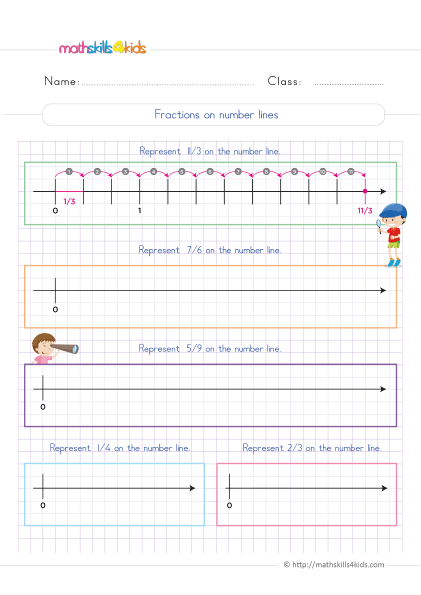
Printable PDF: 6th Grade fractions & mixed numbers practice, 2 pages, answer key included.
See the activity: How to place fractions on a number lineHow to find the least common denominator
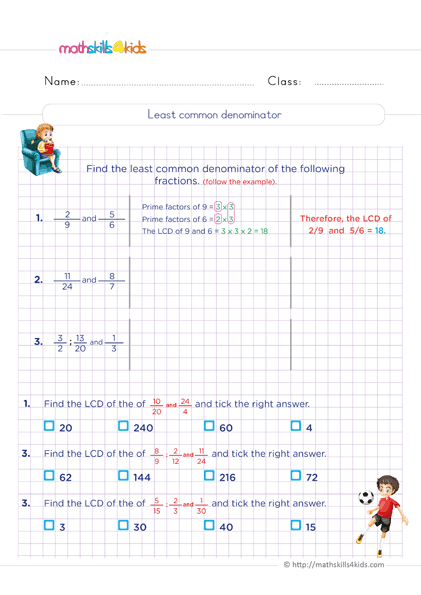
Printable PDF: 6th Grade fractions & mixed numbers practice, 2 pages, answer key included.
See the activity: How to find the least common denominatorCompare fractions with like and unlike denominator
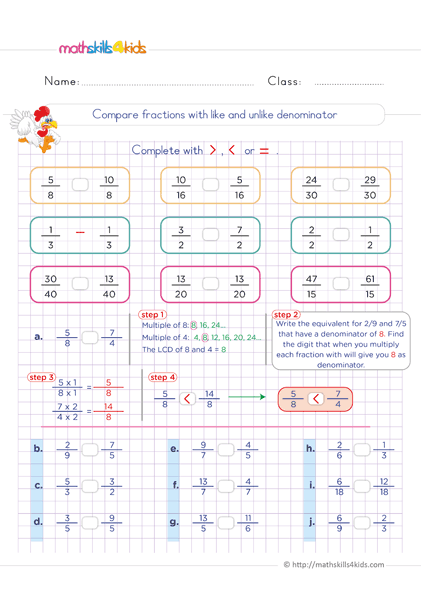
Printable PDF: 6th Grade fractions & mixed numbers practice, 2 pages, answer key included.
See the activity: Compare fractions with like and unlike denominatorComparing fractions word numbers
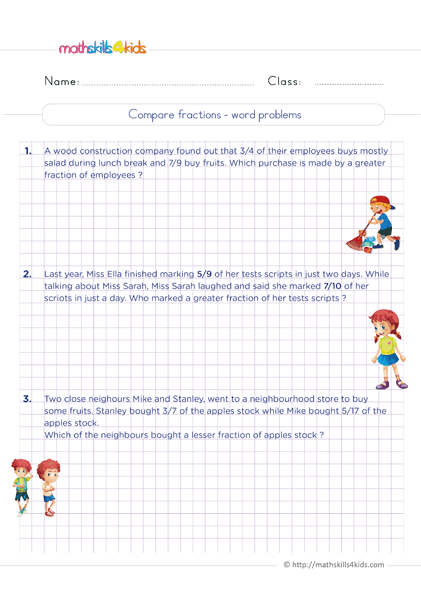
Printable PDF: 6th Grade fractions & mixed numbers practice, 2 pages, answer key included.
See the activity: Comparing fractions word numbersOrdering fractions and decimals
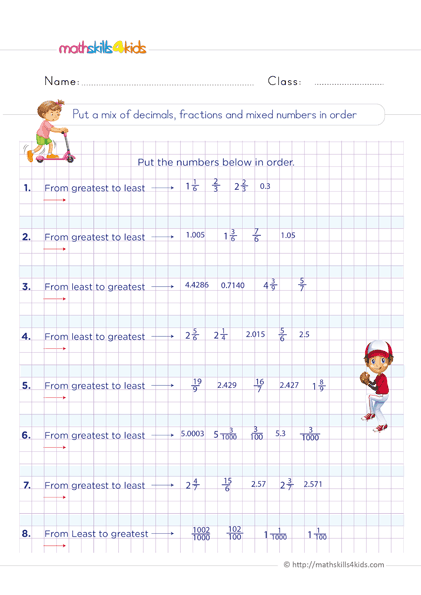
Printable PDF: 6th Grade fractions & mixed numbers practice, 2 pages, answer key included.
See the activity: Ordering fractions and decimalsThe place value of digits in whole numbers
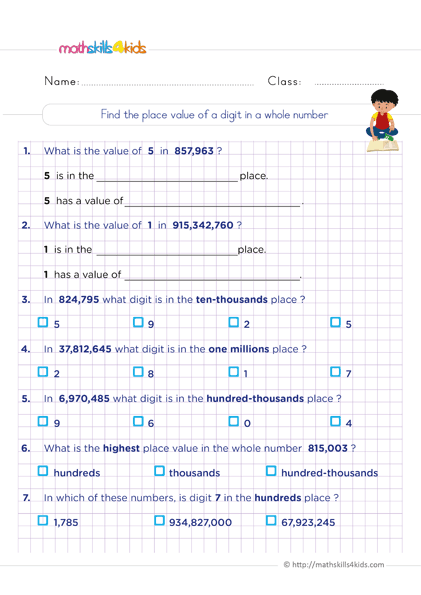
Printable PDF: 6th Grade whole numbers practice, 2 pages, answer key included.
See the activity: The place value of digits in whole numbers