Difference between whole numbers, rational numbers and integers
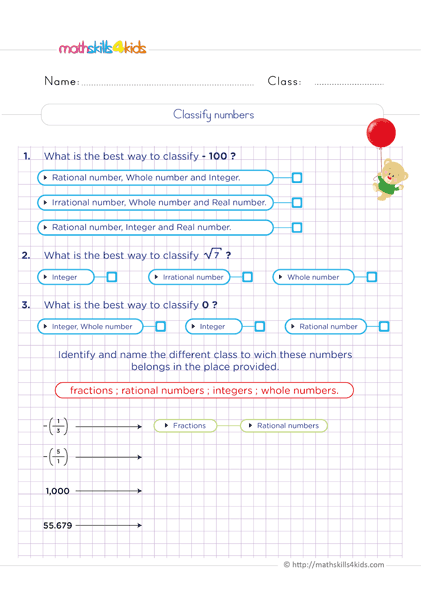
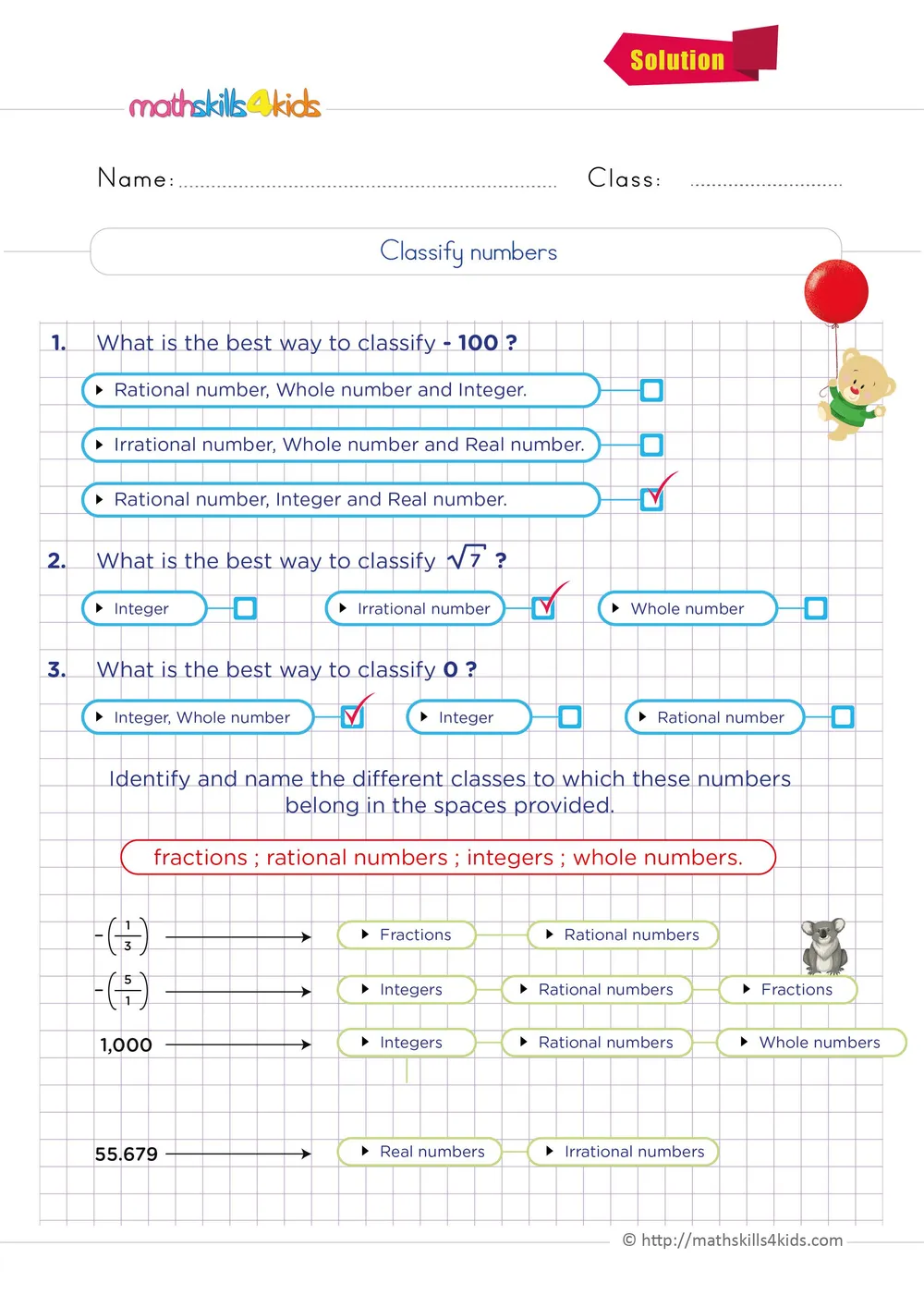
Can a number be a fraction and an integer at the same time? The number -(5/1) is both, and that small surprise is where this page starts. Your child works through three multiple-choice questions, then moves on to classifying rational numbers and integers for four values such as -(1/3) and 1,000. The solution page needs one fix, explained below, on 55.679.
Number families that nest like dolls
Number families nest inside each other. Whole numbers (0, 1, 2, 3 and so on) sit inside the integers, which add the negatives. The integers sit inside the rational numbers: every number you can write as a fraction of two integers, including decimals that stop or repeat.
That nesting is why 0 is a whole number and an integer at once, and why -100 is rational, an integer and real, but not whole. The question about √7 reaches past Grade 6: irrational numbers are an extension, 8.NS.A.1 in Grade 8.
The sixth grade core is 6.NS.C.6, which treats rational numbers as points on the number line, negatives included.
Is 55.679 really irrational?
Read question 1 together and ask, "Can -100 be a whole number?" Most kids say no right away, and that rules out the first two choices.
For -(5/1), let your child argue both sides out loud. "It's a fraction." "It's also -5." Both are true, and the solution page agrees.
A note for you: the solution page marks 55.679 as irrational. It is rational, because the decimal stops: 55.679 is 55,679 over 1,000. Irrational numbers, like √7 in question 2, go on forever without repeating. Ask, "Can you write it as a fraction?" If the answer is yes, it is rational.
Thermometers, prices and a million
Look around the house and you will spot every family. A thermometer reading of -3 degrees is an integer but not a whole number. A price of $2.49 at the store is rational: 249 over 100. Ask your child, "Which family does today's temperature belong to?"
How Much Is a Million? by David M. Schwartz, with its magician Marvelosissimo, makes big whole numbers feel real. After reading, ask whether a million is also an integer and a rational number.
Name what your child did: "You checked every family, not just the first one." This sheet closes the number theory set; the exponents set makes a good review partner.
About this 6th Grade number theory worksheet
Download the worksheet: Difference between whole numbers, rational numbers and integers
Download the PDF (opens in a new tab)Free · 2 pages · 872 KB · answer key included
🍪 Free worksheets are paid for by ads
To download for free, please accept cookies, or go Premium for an ad-free experience.
A few related activities
What are the prime and composite numbers from 1 to 100
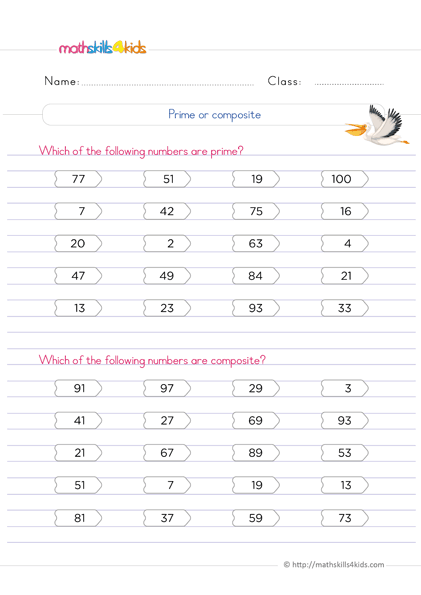
Printable PDF: 6th Grade number theory practice, 2 pages, answer key included.
See the activity: What are the prime and composite numbers from 1 to 100Understand how to write prime factorization with exponents
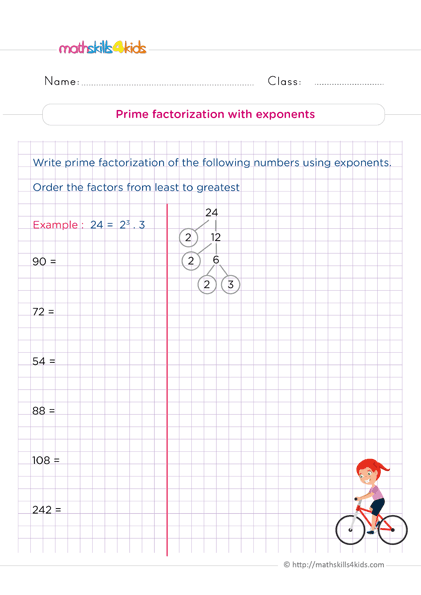
Printable PDF: 6th Grade number theory practice, 2 pages, answer key included.
See the activity: Understand how to write prime factorization with exponentsHow do you find the greatest common factor (GCF)
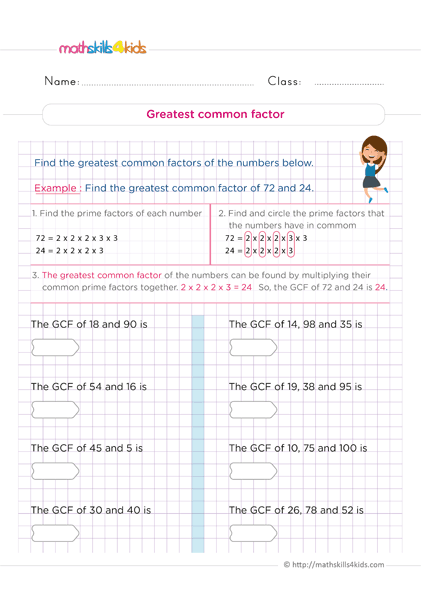
Printable PDF: 6th Grade number theory practice, 2 pages, answer key included.
See the activity: How do you find the greatest common factor (GCF)Least common multiple (LCM) - How to find it
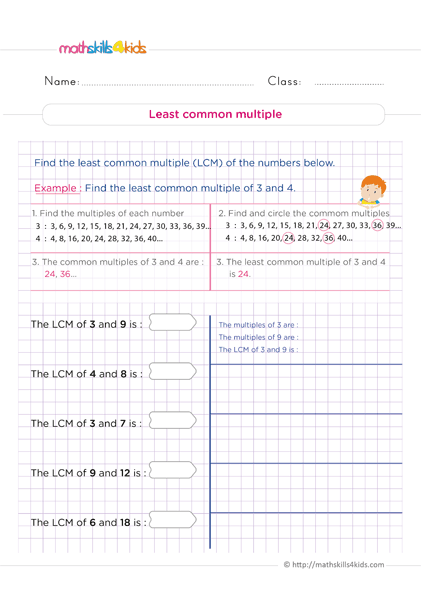
Printable PDF: 6th Grade number theory practice, 2 pages, answer key included.
See the activity: Least common multiple (LCM) - How to find itHow do you find the GCF and LCM in word problems
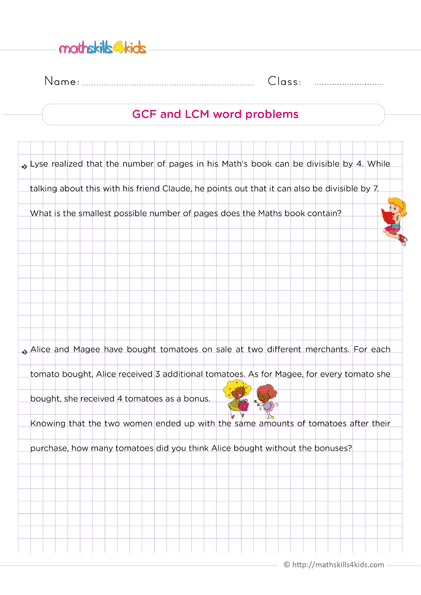
Printable PDF: 6th Grade number theory practice, 2 pages, answer key included.
See the activity: How do you find the GCF and LCM in word problemsThe place value of digits in whole numbers
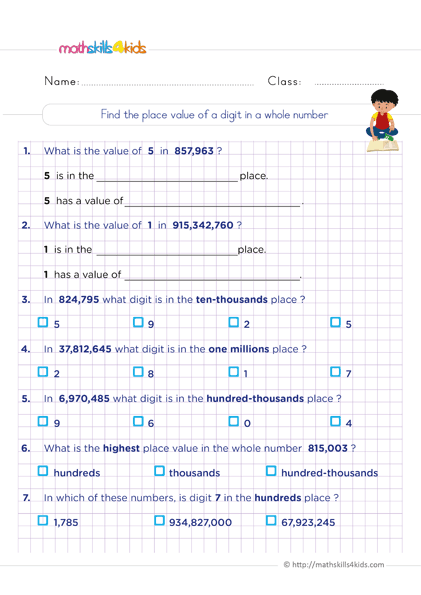
Printable PDF: 6th Grade whole numbers practice, 2 pages, answer key included.
See the activity: The place value of digits in whole numbers