Understand how to write prime factorization with exponents
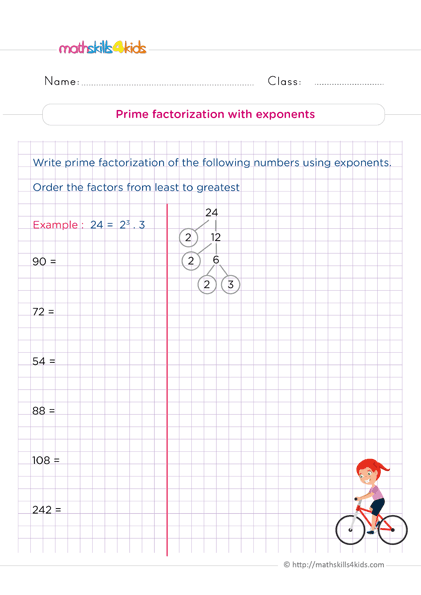
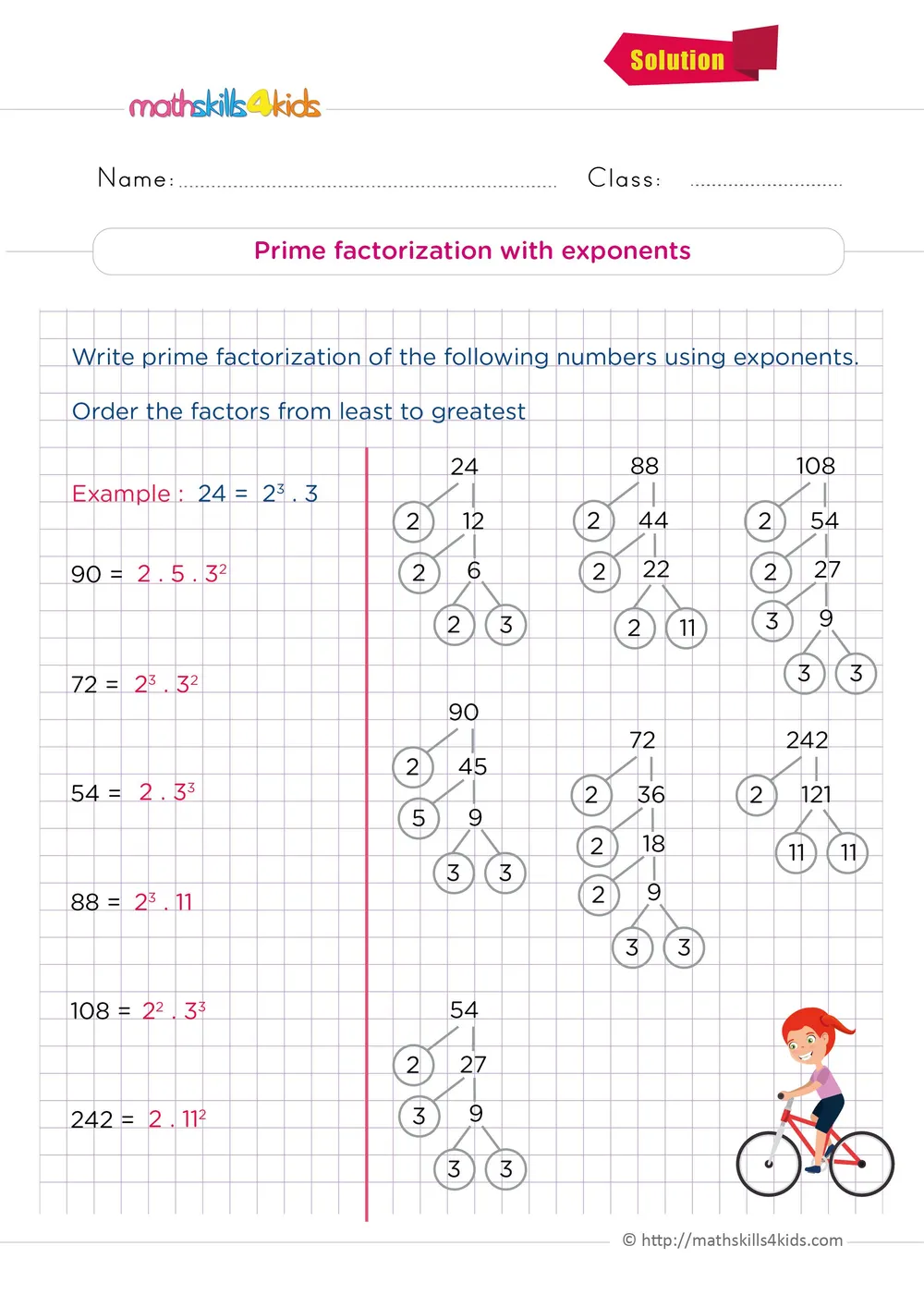
Picture a tree drawn upside down at the kitchen table: 108 at the top, branches splitting until only primes hang at the bottom. That drawing does the hard part. Your child then counts the leaves and finishes the job by writing prime factorization with exponents, as in 2² . 3³, for six numbers from 54 to 242. The solution page shows every tree and every answer, with one order slip on 90.
Every number has one prime recipe
Every whole number greater than 1 breaks into primes in exactly one way, apart from order. That is why a factor tree can start with any split and still end in the same leaves: 72 can open as 2 x 36 or as 8 x 9, and both trees finish with three 2s and two 3s.
The sheet asks for two more things. Repeated primes become powers, so 2 x 2 x 2 x 3 x 3 becomes 2³ . 3², and the factors go in order from least to greatest. The worked example, 24 = 2³ . 3, shows both rules at once.
Writing a power is 6.EE.A.1, whole-number exponents in Grade 6. The tree itself is factor work from Grade 4, put to a new use.
Two 3s or three? Count the leaves
Start with 90, because its tree is short. Your child might split it as 9 x 10 or as 2 x 45; let them choose. When the tree stops, ask, "Is every leaf a prime?" A 9 left at the bottom means one more split.
Then comes the counting. On 108, the leaves are 2, 2, 3, 3 and 3. Ask, "How many 3s, exactly?" Kids often write 3² because they see two 3s on the last branch and forget the one higher up.
Tell your child that the dot between factors means times. A note for you: the solution page writes 90 as 2 . 5 . 3², which breaks the order rule printed at the top. In order it reads 2 . 3² . 5.
A chessboard built from 2s
Prime factorization is a handy tool for sharing fairly. Next time you shop for party supplies, look at a pack of 24 cups: 2³ . 3 says it splits evenly among 2, 3, 4, 6, 8 or 12 kids. Ask, "Which group sizes work for 36 crackers?"
A chessboard is another good one. It has 64 squares, and 64 is 2⁶, a tree with nothing but 2s.
That is the board in The King's Chessboard by David Birch, where a wise man asks for rice doubled on every square, and the king learns too late how fast powers of 2 grow.
Name the effort: "You kept splitting until every branch ended in a prime." Next in this series, the greatest common factor sheet puts these trees to work.
About this 6th Grade number theory worksheet
Download the worksheet: Understand how to write prime factorization with exponents
Download the PDF (opens in a new tab)Free · 2 pages · 725 KB · answer key included
🍪 Free worksheets are paid for by ads
To download for free, please accept cookies, or go Premium for an ad-free experience.
A few related activities
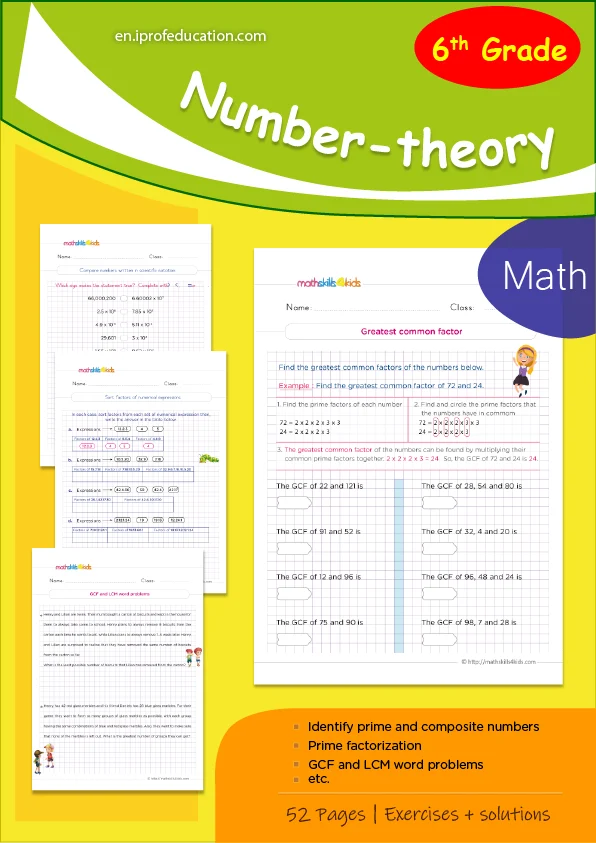
How do you find the greatest common factor (GCF)
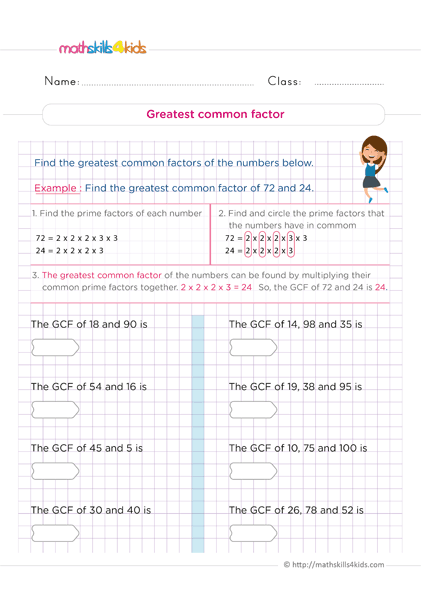
Printable PDF: 6th Grade number theory practice, 2 pages, answer key included.
See the activity: How do you find the greatest common factor (GCF)Least common multiple (LCM) - How to find it
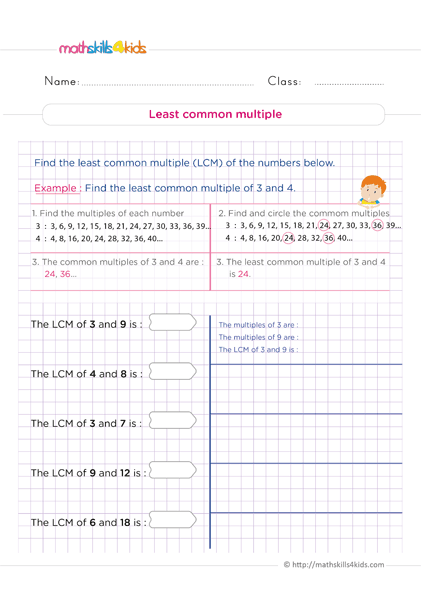
Printable PDF: 6th Grade number theory practice, 2 pages, answer key included.
See the activity: Least common multiple (LCM) - How to find itHow do you find the GCF and LCM in word problems
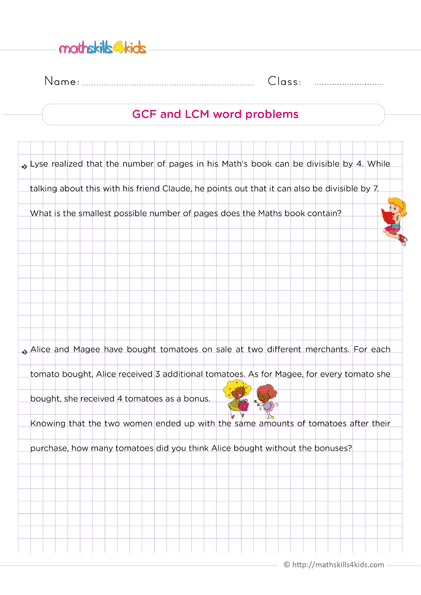
Printable PDF: 6th Grade number theory practice, 2 pages, answer key included.
See the activity: How do you find the GCF and LCM in word problemsDifference between whole numbers, rational numbers and integers
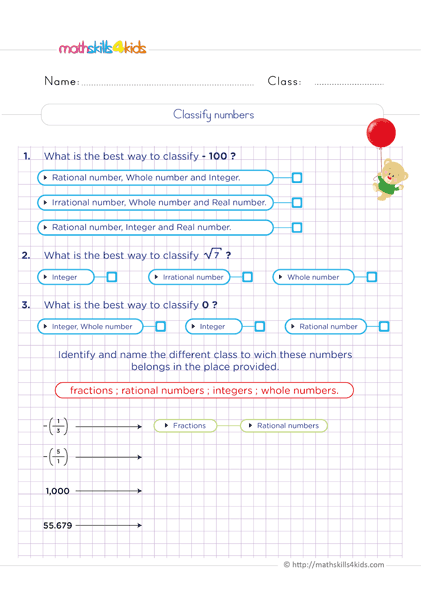
Printable PDF: 6th Grade number theory practice, 2 pages, answer key included.
See the activity: Difference between whole numbers, rational numbers and integersWhat are the prime and composite numbers from 1 to 100
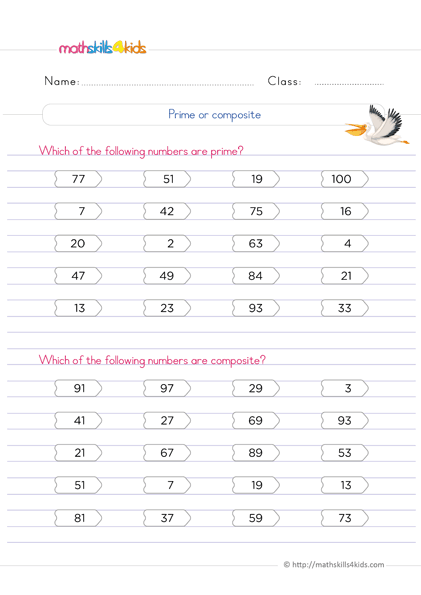
Printable PDF: 6th Grade number theory practice, 2 pages, answer key included.
See the activity: What are the prime and composite numbers from 1 to 100The place value of digits in whole numbers
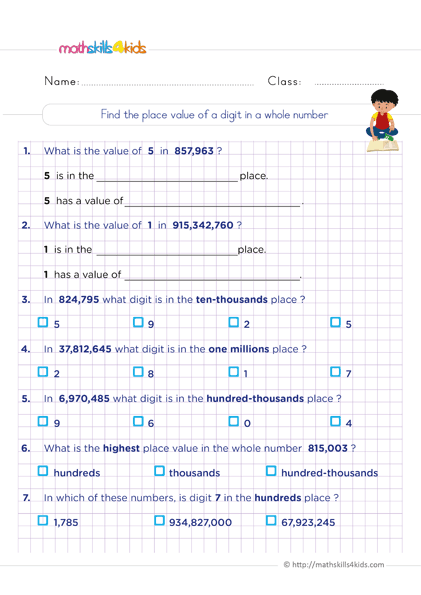
Printable PDF: 6th Grade whole numbers practice, 2 pages, answer key included.
See the activity: The place value of digits in whole numbers